
AWARDED FCA HANDBOOK CONTRACT. BACKED BY MOODY'S INVESTMENT.
Regulatory compliance infrastructure for CCOs and CROs
We build defensible compliance programmes with obligation-level management for CCOs and CROs. Our clients use FinregE as the operational core of their compliance programme, from regulatory change identification through obligation management, gap analysis, implementation, and audit evidence.

CCO accountability is not abstract. It is personal, documented, and increasingly enforced.
The regulatory environment for compliance officers has changed materially in the last decade. What was once a technical function has become a named accountability with personal consequences.
SM&CR
The Senior Managers and Certification Regime assigns specific regulatory responsibilities to named senior managers, including the Chief Compliance Officer where the Compliance Oversight function is a prescribed responsibility under FCA and PRA rules.
Under SM&CR, the CCO must be able to demonstrate that they took reasonable steps to prevent regulatory breaches in areas within their responsibility. The standard is not whether the firm was compliant. It is whether the CCO implemented a reasonable compliance programme designed to achieve compliance.
SEC CCO liability
The SEC has brought enforcement actions against Chief Compliance Officers personally, not only for deliberate wrongdoing, but for what it characterised as compliance programme failures that a reasonable CCO would have prevented.
SEC Rule 206(4)-7 requires registered investment advisers to adopt compliance policies and procedures reasonably designed to prevent violations. The SEC’s Division of Examinations tests this by asking whether the CCO can demonstrate that the firm identified its specific obligations and implemented a programme designed to address each one.
FAR
The Financial Accountability Regime extends the accountability model to Australian regulated entities. Accountable persons, including CCOs and CROs, must take reasonable steps within their areas of accountability.
APRA and ASIC are clear that reasonable steps require systematic, documented compliance programme management, not best-effort or informal approaches. The question is not whether the programme existed in principle, but whether it was structured, maintained, and evidenced in a way that stands up to scrutiny.
FinregE does not just help compliance teams work more efficiently. It builds the documented, structured, continuously maintained compliance programme that protects the CCO and CRO personally — by making their reasonable steps visible and evidenced.
The specific operational failures FinregE addresses
Five problems every CCO recognises. One platform that addresses all of them.
Not more alerts. Not more spreadsheets. Not more manual assembly.
FinregE is built for the operational failures that make compliance programmes harder to defend: too much monitoring effort, too little evidence, incomplete obligation visibility, uncertainty over coverage, and reporting that has to be rebuilt every time.
The manual monitoring burden
Compliance teams spend a significant share of their capacity monitoring regulatory change before any real assessment work begins.
FinregE removes that layer. Relevant updates arrive pre-filtered to the firm’s regulatory footprint, pre-interpreted by AI RIG, and ready for assessment. The team starts where judgment is actually required.
The evidence gap
Compliance activity may happen, but proving it retrospectively under examination pressure is unreliable, slow, and expensive.
FinregE creates the audit trail continuously. Every regulatory change is identified, assessed, owned, implemented, and evidenced as part of the normal workflow. The evidence exists before anyone asks for it.
The obligation blind spot
Most firms do not hold a complete, structured inventory of the specific obligations imposed on them, which creates uncertainty the moment a regulator or auditor asks.
AI RIG extracts and structures the obligation inventory automatically from the Digital Rulebook. The result is complete, current, searchable, and auditable.
The coverage uncertainty
Knowing policies exist is not the same as knowing they address every specific obligation.
RIG MAPS compares every obligation against internal documents simultaneously, showing what is fully covered, partially covered, or missing. The CCO can see exactly what an examiner is likely to find.
The reporting burden
Board packs, ExCo updates, and committee reporting often require manual compilation from multiple disconnected sources.
FinregE generates management information directly from the platform: regulatory change portfolio, obligation coverage status, assessment completion rates, overdue items, and more without manual assembly.
What FinregE looks like in practice
The compliance programme has changed. Here is what the CCO sees when regulatory change, obligation management, audit evidence, and board reporting all live in one place.
The regulatory feed
The compliance team arrives to a curated feed of regulatory updates from over the weekend, filtered to the firm’s regulatory footprint and pre-interpreted by AI RIG.
Each relevant update includes a structured briefing note covering the executive summary, critical dates, scope, and action required. Updates requiring no action are flagged for closure. Updates requiring assessment are routed into the impact assessment workflow with AI RIG’s pre-populated analysis already in place.
The CCO opens the dashboard and sees assessment status across all active regulatory changes, days to deadline, ownership assignments, and a clear view of what is in progress and what is overdue. Nothing is in an email inbox. Nothing is in someone’s head.
Board preparation
The risk committee pack is due. The regulatory risk section used to take most of Wednesday afternoon: pulling updates from the compliance team, checking the status of each open regulatory change, and manually formatting a summary for non-technical board members.
With FinregE, the management information is generated from the platform: regulatory change volumes by theme and jurisdiction, assessment completion rates, obligation coverage metrics, and a summary of the most significant upcoming regulatory deadlines.
The CCO reviews and contextualises. The data is already there.
The auditor call
Internal audit asks for evidence that the firm’s response to DORA was systematic and complete. The CCO opens the FinregE audit trail for the DORA regulatory change programme.
Every publication identified, every obligation extracted by AI RIG, every impact assessment completed, every policy update triggered, every control recommendation reviewed, every action closed, and every piece of evidence attached is already there.
The timeline shows what happened, when it happened, and who was responsible at each step.
The regulatory examination
The FCA examination team asks for the firm’s approach to Consumer Duty obligation management. The CCO produces the FinregE obligation inventory for Consumer Duty: every obligation under the four outcomes, structured by applicable business line, and mapped to the internal policies and controls that address each one.
Coverage status is visible for every obligation — fully covered, partially covered, or not covered — alongside the testing history for each one.
When the examination team asks whether any gaps were identified, the CCO shows the RIG MAPS analysis: the specific gaps found, the rationale for each, and the remediation actions completed.
The audit trail was not assembled for the call. It exists continuously as a by-product of doing the compliance work in FinregE rather than across email, spreadsheets, and informal conversations.
The compliance programme before and after FinregE
Seven moments that define a CCO’s year. Two very different experiences.
The complete compliance operating layer for US and Canadian financial services
The specific FinregE capabilities that matter most to compliance leaders
The platform capabilities that matter most from the CCO’s chair.
Automated regulatory monitoring
FinregE monitors 2,000+ regulatory and legislative sources across 160+ countries — FCA, PRA, SEC, FINRA, ECB, EBA, MAS, APRA, BaFin, AMF, and every other regulator relevant to the firm’s operations.
Every relevant update is captured within 24 hours of publication, interpreted by AI RIG, and delivered to the compliance team pre-filtered and pre-analysed. The monitoring layer that currently consumes compliance team capacity is replaced with automated infrastructure, so teams recover hours each week and redirect that time to assessment and implementation work.
AI RIG — regulatory intelligence without hallucination
AI RIG answers compliance questions about specific regulatory updates, obligation applicability, and how a rule has changed between versions — with greater than 90% accuracy, in under five seconds, and with every answer cited to source.
For CCOs who currently rely on external counsel for regulatory interpretation, or on the institutional knowledge of team members who may leave, AI RIG provides consistent, cited, auditable regulatory intelligence on demand. Every output is grounded in regulatory text. It cites. It does not speculate.
Complete obligation inventory
AI RIG extracts every specific obligation applicable to the firm from its Digital Rulebook — what must be done, by whom, by when, and under what conditions.
The obligation inventory is complete by design, not by memory. It is structured, searchable, and continuously maintained as regulations change. When a regulator or auditor asks for the firm’s obligation inventory, the answer is already in the platform — not assembled retrospectively under pressure.
Gap analysis
RIG MAPS maps every obligation against every internal policy, procedure, and control simultaneously, returning a coverage status for each obligation: fully covered, partially covered, not covered, or not relevant.
For each gap, RIG MAPS provides the specific rationale — what the obligation requires that the document does not address — and generates draft policy language to close it. The CCO who runs RIG MAPS before an examination sees exactly what the examination team will find, with no surprises left hidden in the programme.
Continuous audit trail
FinregE records every action across the regulatory change management lifecycle — who identified the change, what AI RIG assessed, what triage decision was made, who conducted the impact assessment, what conclusions were reached, what implementation actions were created, who owned them, when they were completed, and what evidence supports every decision.
This audit trail is not assembled when a regulator asks. It exists continuously as a by-product of the compliance workflow, giving the CCO evidence that is already documented, structured, and ready to present.
Management information
FinregE generates management information directly from the platform — regulatory change volumes by theme, jurisdiction, and publication type; assessment completion rates and outstanding items; obligation coverage metrics by regulatory framework and business line; days to deadline across the change portfolio; and compliance programme performance over time.
The CCO who used to spend a day compiling a board pack now reviews and contextualises data that FinregE has already generated, creating faster reporting with stronger visibility and far less manual assembly.
The compliance operating layer built for accountable leaders
FinregE gives CCOs and CROs one operating layer for regulatory monitoring, obligation management, policy and control mapping, implementation tracking, and audit evidence.
Regulatory intelligence prepared for action
FinregE delivers a curated view of regulatory change that is filtered to the firm’s footprint and prepared for assessment before the team begins its review.
Instead of spending time triaging scattered alerts, reading source websites, and interpreting raw publications, compliance teams receive structured updates with summaries, critical dates, scope, and likely action points already in place. That moves the team closer to where judgement is actually needed.
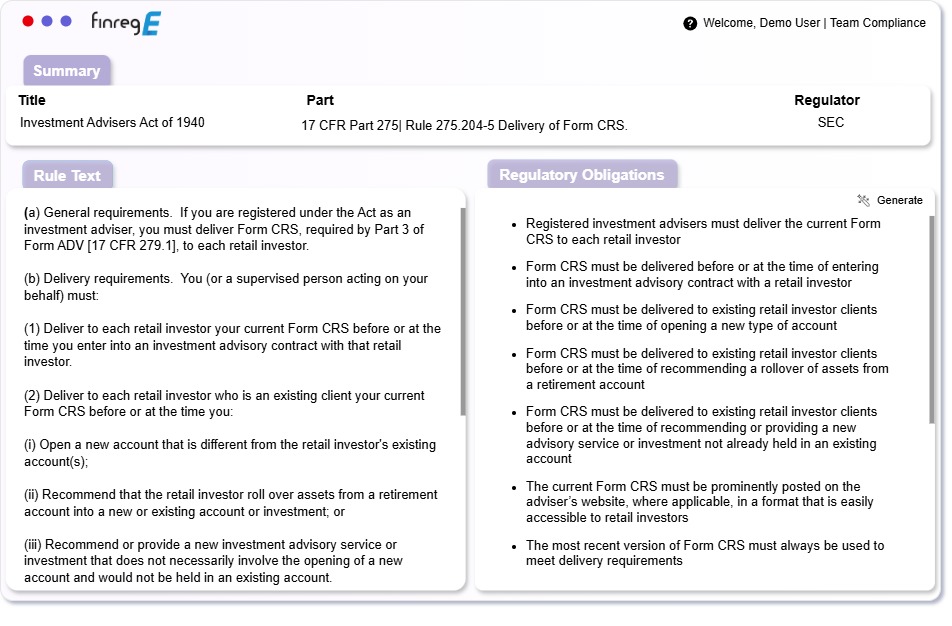
Obligation inventories you can defend
AI RIG extracts and structures obligations so CCOs and CROs can work from a current, searchable record of what the firm is actually required to do.
That changes the conversation materially. When a regulator, auditor, or board member asks what obligations apply, the answer is not assembled retrospectively from multiple sources. It already exists in the programme, in a form that is structured, reviewable, and easier to defend.
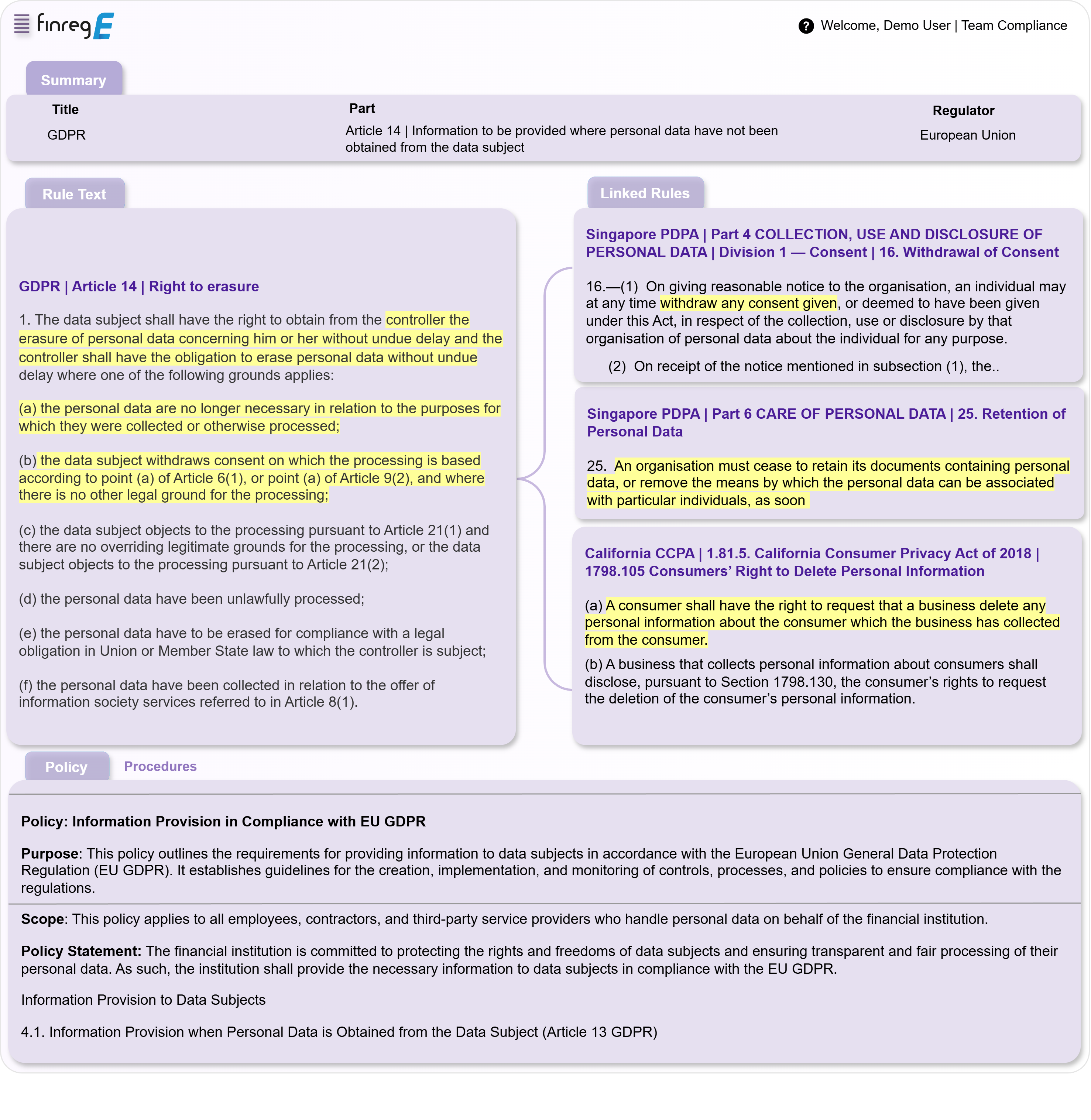
Digital Rulebooks built around the firm’s real footprint
FinregE creates a Digital Rulebook shaped to the firm’s regulatory environment, with relevant rules structured consistently, connected across versions, and available for fast interpretation.
This replaces the usual mix of bookmarks, PDFs, email folders, and internal memory with a regulatory knowledge layer that is easier to search, compare, and use in practice. For leadership teams, that means stronger visibility into the framework the programme is actually managing.
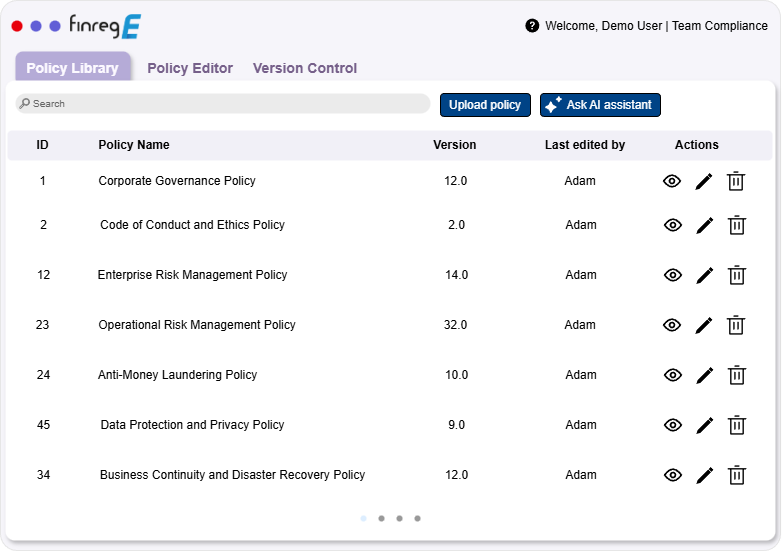
Policies, controls, and evidence connected in one system
FinregE helps firms connect regulatory change to the internal frameworks that matter most: policies, controls, risks, standards, and testing activity.
That means change does not stop at identification. The platform helps show where it lands internally, what needs to move, who owns the response, and how the resulting action will be evidenced. For CCOs and CROs, that creates a more joined-up compliance operating model and a stronger basis for accountability.

Gap analysis that shows where risk really sits
RIG MAPS compares obligations against internal documentation and highlights what is fully covered, partially covered, or missing.
That gives CCOs and CROs a much clearer view of where the programme is strong, where it is exposed, and what needs remediation. Instead of relying on broad assurance or assumed coverage, leaders can see where the real risk sits at obligation level.
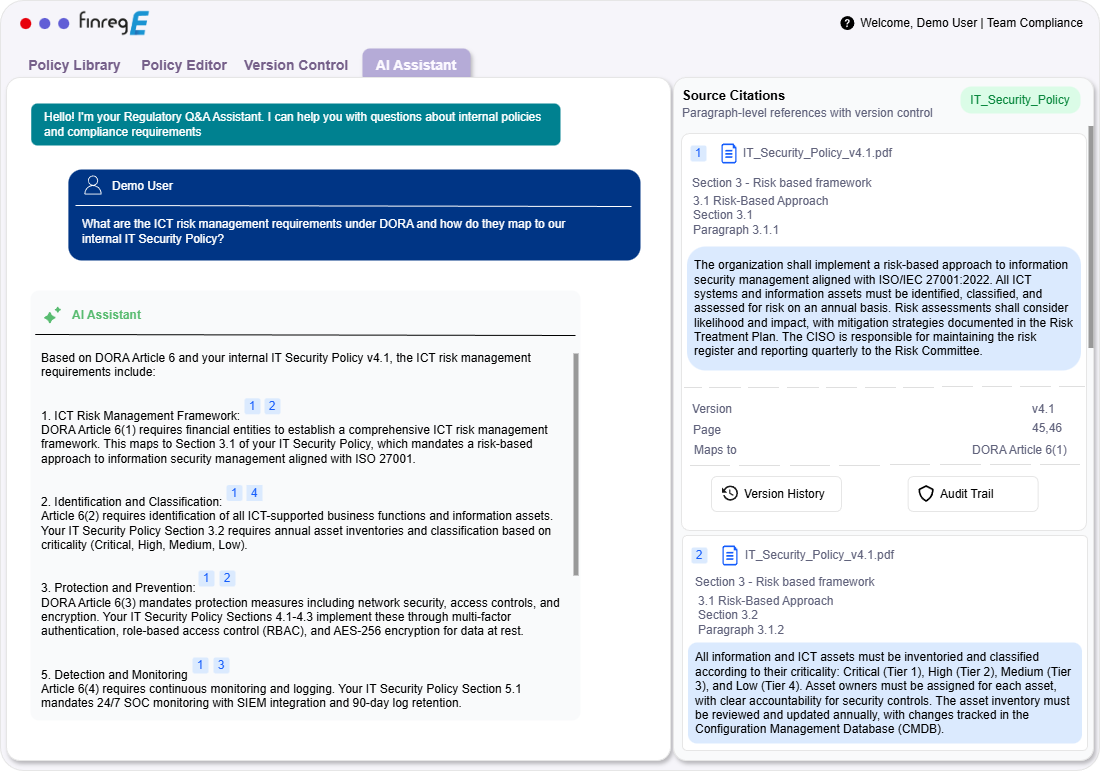
AI RIG for faster, cited compliance understanding
AI RIG helps teams move from regulatory text to usable compliance analysis faster. It summarises developments, extracts obligations, supports impact assessment, and produces structured answers grounded in the underlying material.
For leadership teams, the benefit is not simply speed. It is consistency, clearer interpretation, and a programme that is easier to explain upward, execute internally, and evidence under scrutiny.
What compliance leaders report after deploying FinregE
Measurable outcomes from firms using FinregE as the operational core of their regulatory change and compliance programme.
Less manual compliance workload
The monitoring and triage burden that consumed compliance team capacity is materially reduced.
Lower risk of missing relevant change
Comprehensive monitoring across the full regulatory footprint reduces exposure to missed updates.
Monthly reduction in compliance costs
Per client benchmark across banking and insurance deployments.
To measurable return
Compliance teams begin recovering capacity within the first month of implementation.
Use FinregE as primary infrastructure
Every FinregE client uses the platform as their primary regulatory change management infrastructure.
What FinregE means specifically for the CRO function
The CRO’s primary regulatory risk question is the same as the CCO’s. The lens is different.
Chief Risk Officers approach regulatory compliance from a risk management perspective. Their primary concern is not programme management but risk measurement: where is the firm’s regulatory risk exposure, which obligations are not covered by adequate controls, and how does that risk sit within the wider framework? FinregE answers those questions at the obligation level through systematic, AI-powered gap analysis rather than subjective, incomplete assessments.
Regulatory risk measured at the obligation level
RIG MAPS produces a quantified view of regulatory risk by showing what percentage of the firm’s obligations are fully covered, partially covered, or not covered at all.
For each uncovered obligation, the specific regulatory consequence of non-compliance is identifiable from the underlying text. The CRO gains a risk view that is specific, evidenced, and updated automatically as regulations and internal documents change.
Regulatory change risk with early visibility
When a new regulatory change is captured by Horizon Scanning, AI RIG immediately assesses the new obligations it creates and flags where existing controls may need to be updated.
The CRO sees emerging regulatory risk at the point of publication, not weeks later when manual assessment completes. The regulatory risk register is no longer updated periodically. It is updated continuously.
Connected directly to the risk framework
Every obligation in the FinregE inventory is linked to the risk associated with non-compliance, feeding directly into the risk framework and making regulatory risk visible at the obligation level.
When obligations change, the risk register reflects that change. When new obligations are extracted from a regulatory development, the risk implications become visible immediately, before the compliance programme has formally completed its assessment.
Board risk reporting grounded in evidence
Board reporting draws from FinregE’s management information: obligation coverage metrics, regulatory change volumes by risk theme, days to deadline across the change portfolio, and trend analysis showing whether the firm’s regulatory risk position is improving or deteriorating.
The CRO’s qualitative narrative is grounded in quantified platform data, not estimated from incomplete information compiled across multiple systems.
The documentation that makes the CCO and CRO defensible
What does a reasonable compliance programme look like? It looks like FinregE.
The standard against which CCO and CRO conduct is measured — under SM&CR, under SEC Rule 206(4)-7, under APRA FAR — is the reasonable steps standard. The compliance leader who can demonstrate that they implemented a systematic, documented, continuously maintained programme has taken a materially different position from one relying on institutional memory, informal monitoring, and periodic consultant engagements.
Professional protection starts with documented evidence
FinregE turns the core elements of a reasonable compliance programme into structured, continuously maintained records — available before an examiner, auditor, or board asks.
Obligation identification
AI RIG extracts and structures every specific obligation from the regulatory framework applicable to the firm.
Coverage assessment
RIG MAPS documents which obligations are covered by internal policies and controls, which are partially covered, and which are not covered — with specific rationale for every gap.
Gap remediation
Remediation actions triggered by RIG MAPS analysis are tracked through to completion, with evidence of implementation attached.
Regulatory change response
Every regulatory change is documented from identification through assessment, ownership, implementation, and evidence — with a complete, timestamped audit trail.
Testing
The Compliance Monitoring Plan draws its obligation inventory from FinregE, ensuring every obligation is tested and the results are recorded.
Management oversight
Board and ExCo reporting generated from FinregE demonstrates that regulatory risk was brought to senior management and the board at appropriate intervals.
Questions compliance leaders ask when evaluating FinregE
These are the practical questions CCOs and CROs ask when assessing whether a platform can support a defensible compliance programme, reduce manual effort, and improve audit readiness.
How does FinregE help CCOs demonstrate a defensible compliance programme?
FinregE builds the documented infrastructure that makes a compliance programme defensible: a complete obligation inventory extracted by AI RIG, an objective gap analysis mapping every obligation to internal documents using RIG MAPS, a continuous audit trail of regulatory change responses, and management information showing programme coverage and performance.
Under SM&CR, SEC Rule 206(4)-7, and APRA FAR, the standard for CCO accountability is whether they implemented a reasonable, systematic compliance programme. FinregE makes that programme visible and evidenced, not merely asserted.
How does FinregE reduce the manual burden on compliance teams?
FinregE’s Horizon Scanning automates the regulatory monitoring function by capturing 2,000+ regulatory sources across 160+ countries, with AI RIG interpreting every publication and producing a structured briefing note.
Compliance teams that previously spent significant capacity monitoring regulatory change, reading regulator websites, and processing email subscriptions instead receive a pre-filtered, pre-interpreted feed of relevant updates. The monitoring layer is replaced with automated infrastructure, so teams recover hours each week for assessment and implementation work.
What does FinregE’s audit trail contain?
FinregE records every action in the regulatory change management lifecycle: who identified the change, what AI RIG’s assessment concluded, what triage decision was made, who conducted the impact assessment, what the assessment found, what implementation actions were created, who owned each action, when it was completed, and what evidence supports every decision.
Every change, every action, and every decision is timestamped and attributed. This audit trail is continuous, created as a by-product of the compliance workflow rather than assembled retrospectively when a regulator or auditor asks.
How does FinregE support board and committee reporting on regulatory risk?
FinregE generates management information directly from the platform: regulatory change volumes by theme and jurisdiction, assessment completion rates and outstanding items, obligation coverage metrics by regulatory framework, days to deadline across the change portfolio, and trend analysis over time.
CCOs and CROs use this data to generate board and committee reporting without manual compilation from multiple source systems. The quantified regulatory risk data from FinregE provides objective grounding for the qualitative risk narrative presented to governance bodies.
How quickly does FinregE show results after implementation?
Most FinregE clients report measurable results within the first four weeks of deployment. Compliance teams recover capacity as the manual monitoring function is replaced by automated Horizon Scanning, and the first AI RIG-powered impact assessments demonstrate the difference in speed and completeness versus manual approaches.
With a typical implementation timeline of 4 to 12 weeks, full deployment is usually complete within a quarter, with measurable ROI evident in the same period through reduced consultant spend, recovered capacity, and improved examination readiness.
Does FinregE cover regulatory requirements across multiple jurisdictions?
Yes. FinregE monitors regulatory requirements across 160+ countries, including the UK (FCA, PRA), the EU (ECB, EBA, ESMA, EIOPA and national competent authorities), North America (SEC, FINRA, OCC, CFPB and all 50 US state regulatory bodies), Asia Pacific (MAS, APRA, HKMA, FSA Japan), and global standard setters such as FATF, the Basel Committee, and IOSCO.
For CCOs and CROs managing multi-jurisdictional compliance programmes, FinregE provides a single platform view of the regulatory footprint across all operating jurisdictions, with AI RIG producing English-language obligation extracts from non-English regulatory publications where needed.
How does FinregE help with regulatory examination preparation?
FinregE makes examination preparation a function of the normal compliance workflow rather than a separate project. The obligation inventory, the coverage analysis, the gap remediation record, and the audit trail of regulatory change responses are continuously maintained in the platform and available immediately when an examination is announced.
CCOs who use FinregE for day-to-day compliance management arrive at regulatory examinations with documented evidence that already exists, rather than assembling it retrospectively under time pressure.
See what a defensible compliance programme looks like in practice
When regulatory change, obligation management, audit evidence, and reporting live in one place, the programme operates differently. Teams spend less time assembling information and more time exercising judgement.
UK FCA Handbook
Selected by the UK Financial Conduct Authority through a competitive process to redesign, host, and manage the FCA Handbook, helping make regulation easier to navigate, compare, and apply.
Moody's investment
Backed by Moody’s Corporation, one of the world’s leading financial data and analytics organisations, reinforcing FinregE’s long-term credibility and strategic relevance.
Global partnerships
FinregE collaborates with leading regulators and organisations across sectors to innovate and solve real-world regulatory challenges.
When the board asks, the evidence should already exist
The strongest compliance programmes are not rebuilt for examinations, audit requests, or committee papers. They are structured so the evidence already exists as a by-product of doing the work properly.
FinregE helps CCOs and CROs build that kind of programme: visible, documented, and continuously maintained.