Stablecoins have entered the part of regulation that compliance leaders cannot afford to misread. The FDIC’s proposal looks like a rulebook for issuers. In practice, it is a governance test for any institution touching digital money.
Most firms still talk about stablecoins as a product decision. The FDIC is starting to regulate them as a control environment.
That is the uncomfortable reframe embedded in the FDIC’s notice of proposed rulemaking, to implement parts of the GENIUS Act for FDIC-supervised permitted payment stablecoin issuers and insured depository institutions. The headline obligations are visible: reserve backing, redemption timelines, disclosure standards, yield restrictions, reporting, examination. The subtler and more consequential signal is what sits underneath those obligations.
The FDIC is not just regulating a product category. It is shutting down governance drift between product categories that the market has been deliberately keeping adjacent.
Payment stablecoin. Tokenized deposit. Reserve-backed digital money. These have operated in legal and commercial grey space because letting them stay blurry was convenient. The FDIC is ending that convenience. Every institution with a digital money strategy, whether it is an issuer, a custodian, a reserve deposit counterparty, or a firm evaluating its options, now has a hard classification decision to make. And the compliance, legal, and risk infrastructure to support that decision must be in place before June 9, 2026, when comments close, and well before January 18, 2027, when the GENIUS Act becomes effective.
Why This Proposal Is Not an Isolated Stablecoin Event
The FDIC’s proposal sits inside a wider federal effort to operationalise the GENIUS Act across agencies. Read in isolation, it looks like targeted sector regulation. Read in context, it is one piece of a U.S. stablecoin rulemaking architecture that is hardening rapidly — and that will affect institutions well beyond those actively pursuing issuances.
TWO ISSUES THAT MATTER BEYOND STABLECOIN ISSUERS
First: deposits held as reserve assets for payment stablecoins would be insured to the permitted payment stablecoin issuer as corporate deposits, not to stablecoin holders on a pass-through basis. The reserve account may carry FDIC protection for the issuer. The token holder does not inherit that protection.
Second: tokenized deposits remain deposits if they meet the statutory definition under the Federal Deposit Insurance Act. The technology used to record or transfer the liability changes nothing about its legal classification.
Both clarifications have operational implications for institutions that are not issuers, in how they structure reserve deposit relationships and how they classify and govern their own digital money products.
The proposal would also establish requirements around reserve composition, redemption, risk management, reporting, audits, and ongoing supervision for FDIC-supervised permitted payment stablecoin issuers and custodians. The compliance deadline that matters first is the comment window. The effective date that matters most is January 18, 2027 — or 120 days after final implementing regulations, whichever is earlier.
That timeline is not generous. Institutions that treat this as a distant rulemaking event rather than an active implementation challenge will find themselves in the same position, they are always in at regulatory go-live: resolving in weeks what should have been built over months.
The FDIC Is Drawing a Hard Line Between Products That Look Similar and Behave Very Differently
Most commentary on this proposal will focus on reserve backing requirements and redemption timelines. Those matter operationally. The sharper and more strategically important insight sits elsewhere.
The FDIC is using this proposal to force a distinction that many firms have preferred to keep blurry: a payment stablecoin is not a tokenized deposit, and a reserve deposit is not a backdoor route to pass-through insurance for token holders. That distinction has major consequences for how digital money products are classified, governed, disclosed, and evidenced.
Under the proposal, payment stablecoins sit inside a bespoke prudential framework with dedicated requirements across reserves, redemption, disclosures, yield restrictions, risk management, reporting, and examination. Tokenized deposits, by contrast, do not become a new category of liability because distributed ledger technology is used to record or transfer them. If the product meets the statutory definition of a deposit, it is a deposit. The technology does not alter that legal result.
This is where many firms will be caught flat-footed, not because they fail to understand the distinction in abstract terms, but because they have not forced product, legal, treasury, compliance, and technology teams to make that distinction operational.
A digital money proposition can no longer rely on loose internal language, informal category boundaries, or deferred classification decisions. It must be classified, governed, disclosed, and evidenced according to the regime it actually belongs to. Boards and executive teams now face a sharper internal debate: does the digital money strategy belong in a stablecoin structure, a tokenized deposit structure, or a broader payments modernisation programme? Those are not branding choices. They are legal, prudential, and supervisory choices, and the FDIC is insisting they be made explicitly.
Six Requirements That Create Real Implementation Work
The proposal creates obligations that cut across compliance, legal, treasury, finance, product, data, technology, and executive oversight. The following six areas represent where implementation work is most demanding — and where the distance between understanding the rule and operationalising it is greatest.
- Reserve Management: From Treasury Problem to Traceability Problem
The proposal would require permitted payment stablecoin issuers to maintain identifiable reserves that fully back outstanding stablecoins on at least a one-to-one basis. Those reserves must be trackable to show which assets back which stablecoin. Where an issuer operates more than one publicly distinguishable brand, reserves must be separately identifiable and generally segregated by brand.
That sounds clean in regulatory language. Operationally, it requires compliance to work with treasury, finance, and data teams to evidence reserve attribution, intraday monitoring, fair value measurement, segregation logic, and escalation triggers when reserve value drops below required thresholds. The reserve asset list is intentionally narrow: cash, Federal Reserve balances, demand deposits, qualifying short-dated Treasuries, certain repo and reverse repo arrangements, and qualifying government money market fund exposures. Exposure to any one eligible financial institution is capped at 40 percent of reserve assets — forcing concentration management into the product design itself.
THE GOVERNANCE QUESTION RESERVE MANAGEMENT RAISES
Can your institution show — not assert — exactly what backs what, where it sits, how it is valued, and how quickly it can be monetised? That is the supervisory test. If the answer requires manual reconstruction after the fact, the reserve framework is not compliant in practice even if it is compliant on paper.
- Redemption: An Operational Promise That Must Survive Stress
The proposal would require a public redemption policy and define timely redemption as no later than two business days following a redemption request, unless the FDIC grants an extension. Immediate notice to the FDIC would be required when aggregate redemption requests exceed 10 percent of outstanding issuance value within a 24-hour period.
That is not just a policy drafting exercise. It creates sequencing demands across liquidity access, treasury workflows, customer operations, fraud controls, escalation governance, and communications. If a firm cannot demonstrate how it would process redemption stress in a way that matches its published commitments, the risk spills beyond the redemption function directly into disclosures, governance, and supervisory credibility.
- Marketing and Product Architecture: Closer to Enforcement Risk Than Most Teams Realise
A permitted payment stablecoin issuer may not market a stablecoin as legal tender, as issued by the United States, as government-guaranteed, or as subject to Federal deposit insurance. It also may not pay interest or yield solely in connection with holding, using, or retaining the stablecoin, including through certain affiliate and third-party arrangements.
This is where product teams consistently underestimate the compliance burden. The risk is not just a misstatement on a website. It is an ecosystem problem. White-label structures, partnership distribution, affiliate reward mechanisms, and customer-facing explanations all need to be reviewed together. Otherwise, firms create a gap between legal design and commercial messaging that regulators will not ignore.
- Deposit Insurance Clarification: More Than a Technical Update
Deposits held as reserves for a payment stablecoin would be insured as corporate deposits of the PPSI, aggregated with the PPSI’s other corporate deposits at the same insured depository institution, and insured up to the standard maximum deposit insurance amount. They would not be insured to payment stablecoin holders on a pass-through basis.
This cuts directly into market narratives implying that reserve deposits make the token itself an insured product for end holders. The FDIC’s position is the opposite. The reserve account may be insured to the issuer within corporate deposit rules. The token holder does not step into pass-through FDIC protection through that structure. Disclosures, FAQs, partner scripts, and client education materials need immediate scrutiny, firms should not wait for final rules to test whether current language overstates insurance comfort.
- Tokenized Deposits: Not Being Squeezed Into the Stablecoin Regime, But Requiring Their Own Clarity
The FDIC is explicit that tokenized deposits remain deposits if they satisfy the statutory definition. The technology used to record, evidence, or transfer the liability does not alter deposit treatment under the Federal Deposit Insurance Act. A tokenized product meeting the definition of deposit is treated no differently than a non-tokenized deposit.
This has strategic implications that boards and executive teams need to confront: the digital money strategy cannot be deferred. The classification decision is a legal, prudential, and supervisory decision, and it must be made and documented before regulatory questions are asked of the institution externally.
- Supervisory Readiness: The Part Most Firms Will Under-Resource
The proposal supports recurring examinations, prompt access to books and records including distributed ledgers, confidential weekly reporting, quarterly financial condition reports, records retention requirements, and annual audited financial statements for larger issuers.
This is the part institutions consistently under-resource. They focus on whether they can build or launch the product. The FDIC is focused on whether the institution can supervise, attest, report, document, and defend it. Those are fundamentally different readiness tests and they demand different preparation timelines.
From Regulatory Interpretation to Governed Execution: Where FinregE Fits
This is the point where many compliance teams hit the same wall. They understand the rule. They may have a good legal memo on it. But they do not yet have a structured way to convert regulatory interpretation into cross-functional, evidenced action. That is the exact gap this proposal exposes and the gap FinregE is built to close.
The FDIC’s stablecoin framework does not create one task. It creates a chain of them. Reserve rules need treasury and finance input. Redemption expectations need operations and liquidity planning. Deposit insurance clarifications need disclosure review. Tokenized deposit treatment needs legal and product classification. Reporting and audit obligations need data lineage, ownership, and governance. No single team owns all of that. When the chain is managed as a series of disconnected workstreams, implementation gaps and supervisory risks accumulate quietly.
Translation: From regulatory text to structured obligation register
FinregE’s AI RIG helps teams move from reading the document to structuring it. It can help break regulatory text into usable obligations, key themes, dates, and impacts so teams have a clearer starting point for assessment and action. The value is not just faster interpretation. It is a more usable foundation for assigning real work.


Impact assessment: Not every provision hits every institution the same way
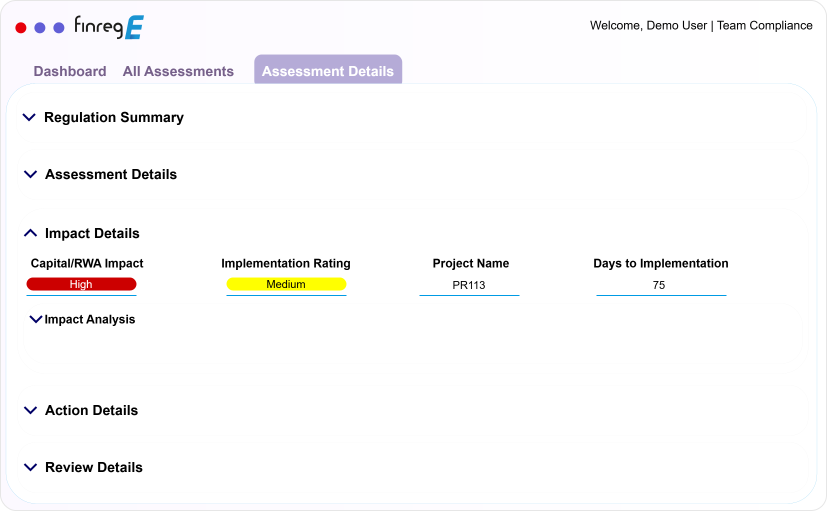
FinregE’s impact assessment workflow helps firms assess regulatory change in a more structured way by linking interpretation to owners, actions, due dates, evidence, and dashboards. That matters in proposals like this because the real burden often sits in scope, applicability, and implementation detail rather than in the headline rule itself.
Coordination: Connecting the regulatory chain to internal owners
The FDIC proposal cuts across compliance, legal, treasury, finance, product, data, technology, and executive oversight. That is where implementation efforts tend to fragment. FinregE’s structured mapping capabilities, including RIGMAPS, help connect regulatory obligations to internal policies, procedures, and controls, identify gaps, and create a more traceable basis for remediation. The gain is practical. Teams spend less time reconciling disconnected interpretations and more time progressing controlled implementation.

Evidence: Building the audit trail as implementation happens, not after
Regulators rarely ask only what conclusion a firm reached. They ask how it reached it, who reviewed it, what was approved, which actions were assigned, and what remains open. FinregE helps firms build that record as they work, through workflow, audit trail, evidence capture, versioning, and reporting, rather than trying to reconstruct it later under pressure.
Horizon scanning: This proposal is one moment in a longer cycle
The FDIC proposal does not sit on its own. It forms part of a much wider digital asset regulatory cycle, where stablecoin oversight, prudential treatment, disclosure expectations, reporting duties, and supervisory standards are evolving in parallel. FinregE’s regulatory horizon scanning helps firms monitor that wider flow of change on a continuous basis, filter out noise, identify the developments that actually matter to their business, and connect those developments into downstream assessment and action.

What Firms Should Be Doing and When
The comment deadline of June 9, 2026, is the first hard date. The GENIUS Act effective date of January 18, 2027, is the compliance horizon. Both are closer than they look when layered against the internal classification, governance, and implementation work that must precede them.
Required Action | Owner | By When | Priority |
Confirm whether any current or planned digital money product should be classified internally as a payment stablecoin, tokenized deposit, or neither | General Counsel / Head of Compliance | Within 2 weeks | Critical |
Review all customer-facing and partner-facing language for claims around FDIC insurance, government backing, legal tender status, or guaranteed stability | Head of Compliance / Product Marketing | Within 2 weeks | Critical |
Identify whether any affiliate, partner, or white-label structure could create prohibited yield exposure in practice | CCO / Legal / Product | Within 3 weeks | Critical |
Map reserve governance requirements: segregation, fair value monitoring, concentration controls, and monetization capability | Treasurer / CFO / Compliance | Within 3 weeks | Critical |
Assess whether current liquidity and operations workflows could support a two-business-day redemption commitment under stress | COO / Treasurer / Head of Operations | Within 4 weeks | High |
Build a cross-functional gap analysis covering reserves, redemption, disclosures, reporting, audit, and supervisory readiness | CCO / PMO / Regulatory Change Lead | Within 4 weeks | High |
Review whether recordkeeping, distributed ledger data access, and evidence retention would satisfy examination demands | CTO / Chief Data Officer / Compliance | Within 5 weeks | High |
Identify reporting impacts: weekly FDIC reporting, quarterly financial condition reports, and potential annual audit requirements | CFO / Regulatory Reporting Lead | Within 5 weeks | High |
Prepare board and executive committee briefing on strategic choices between stablecoin issuance, tokenized deposit models, or non-entry | CCO / CRO / General Counsel | Before next board cycle | High |
Draft consultation response on reserve concentration, redemption timing, reporting burden, and tokenized asset treatment | Public Policy / Legal / Compliance | By mid-May 2026 | Medium |
Finalize internal position and submit comment letter if relevant | General Counsel / Public Policy Lead | June 9, 2026 | Critical |
Stand up a tracked implementation workstream now rather than waiting for final rules | Regulatory Change Lead / CCO | Start immediately | High |
Build a documentary record of all interpretation, impact assessments, and decisions taken in response to the proposal | Compliance Governance / PMO | Ongoing from now | High |
Monitor related U.S. agency stablecoin rulemaking for cross-regulatory dependencies | Horizon Scanning / Reg Intelligence | Ongoing through 2026 | Medium |
Prepare for GENIUS Act effectiveness — use the consultation period to test control design, not just policy positions | Executive Sponsor / Compliance / Ops | Before Jan 18, 2027 | High |
Governance Will Determine Which Firms Win This Regulatory Moment
The market will read this proposal as a stablecoin rule. Compliance leaders should read it as something more consequential: a demand for cleaner classification, tighter disclosures, stronger reserve governance, and supervisory-grade evidence across the full digital money operating model.
The FDIC is not asking whether your institution has a digital money strategy. It is asking whether your governance is rigorous enough to support one. Those are different questions and the second one is harder to answer with a product roadmap.
Firms that move now get time to resolve the hardest questions while they are still strategic choices. Firms that wait will resolve them under the pressure of final rules, internal ambiguity, and supervisory expectation. The preparation time is not a luxury. It is a competitive advantage.
The next phase of stablecoin regulation will not be won by the firms that talk most confidently about innovation. It will be won by the firms that can prove their governance is stronger than their marketing.
See how FinregE maps GENIUS Act obligations to your compliance infrastructure.
From regulatory text to structured obligation register, gap analysis, and supervisory-ready evidence trail — in days, not months.