Waiting for regulations to hit is no Longer an option. That’s according to Rohini Gupta, CEO of FinregE, who provides an indispensable approach to proactive horizon scanning that will resonate with all highly regulated firms.
In today’s hyper-regulated business environment, waiting for new regulations to become binding before taking action is a recipe for compliance failures, costly last-minute implementations and competitive disadvantage. Regulatory horizon scanning has emerged as the critical early-warning system that separates proactive organisations from reactive ones.
This comprehensive Expert Guide explores what regulatory horizon scanning is, why it matters, and provides a step-by-step methodology to implement the most effective horizon scanning program for your organisation.
What is Regulatory Horizon Scanning?
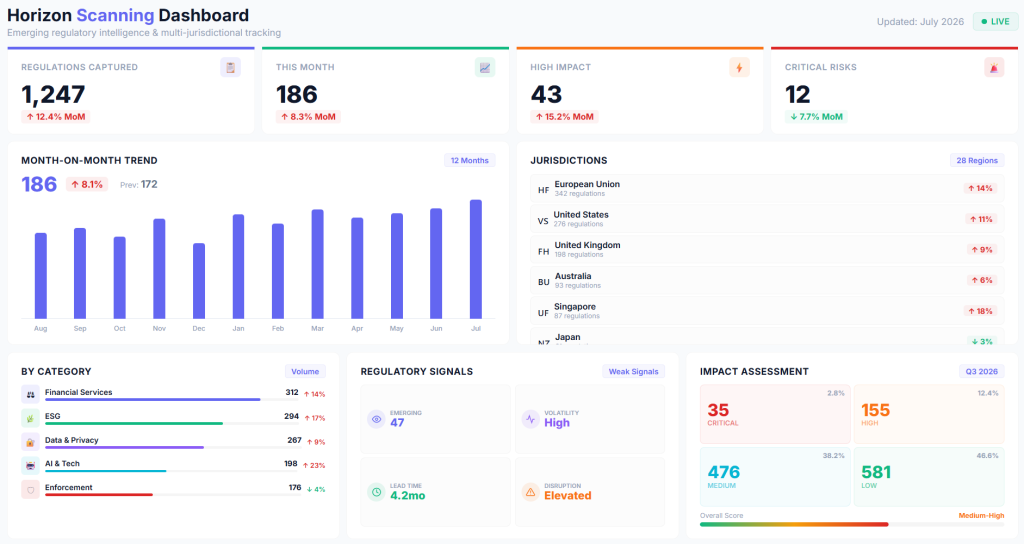
Regulatory horizon scanning is a proactive, systematic early-warning process that identifies, monitors, and assesses emerging laws, rules, guidance, enforcement trendsand policy signals that could affect an organisation’s obligations, risk profile, and strategy.
Unlike traditional compliance monitoring that tracks existing requirements, horizon scanning focuses on the regulatory pipeline — capturing weak signals such as:
- Draft legislation and proposed rules
- Regulatory consultations and white papers
- Committee hearings and policy debates
- Enforcement action trends
- Technical standards development
- Industry self-regulation initiatives
- Technological trends with regulatory implications (AI, fintech, climate finance)
Scope and Coverage
Effective horizon scanning extends beyond formal legislation to encompass:
- Multi-jurisdictional monitoring: Tracking regulations across all relevant geographies
- Cross-functional impact: Assessing implications for products, operations, technology, and strategy
- Standards and guidance: Monitoring industry standards, regulator publications and technical specifications
- Emerging technologies: Identifying regulatory responses to innovations like AI, blockchain and biotechnology
Why Horizon Scanning Matters
Strategic Advantages
- Early Detection and Proactive Response: Organisations can act before rules become binding, enabling:
- Product redesign before launch
- Technology architecture adjustments
- Budget allocation for compliance initiatives
- Competitive positioning ahead of market shifts
- Risk Reduction and Governance
- Reduces surprise regulatory changes
- Supports Enterprise Risk Management (ERM)
- Provides defensible audit evidence of forward-looking oversight
- Strengthens board and supervisory reporting
- Operational Efficiency
- Reduces implementation delays and emergency remediation costs
- Enables phased, planned compliance rollouts
- Improves resource allocation and workforce planning
- Competitive Advantage
- Early movers can shape industry responses
- First-to-market compliant products capture market share
- Enhanced reputation with regulators and stakeholders
Real-World Impact
Case examples demonstrate tangible value:
- EMA (European Medicines Agency): Horizon scanning identified technological enablers for radiopharmaceuticals, informing regulatory preparedness and collaborative capacity building
- UK Point-of-Care Manufacturing: Horizon scanning identified the need to amend medicines regulations, leading to statutory instrument proposals and policy change pathways
- Financial Services: Banks using horizon scanning reduced regulatory change implementation time from months to weeks, avoiding enforcement actions and penalties
The Seven-Step Horizon Scanning Process
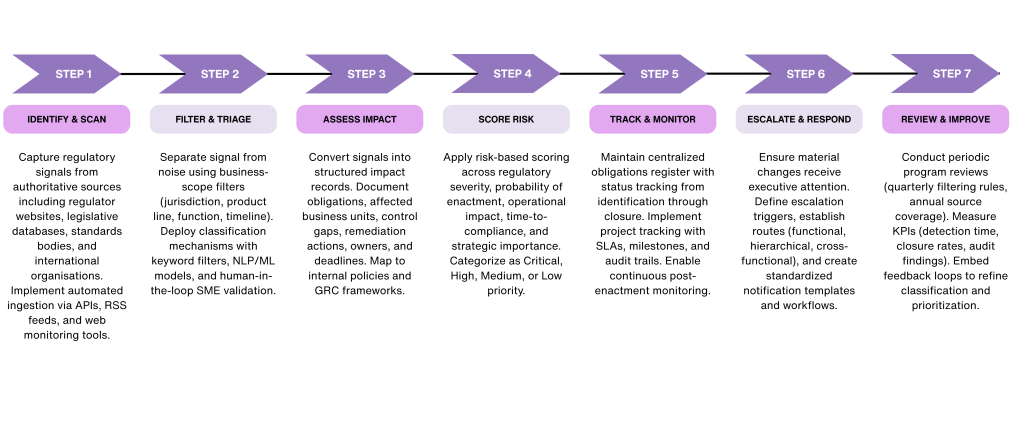
Identification and Continuous Scanning
Objective: Capture all relevant regulatory signals from authoritative sources
Actions:
- Build your regulatory universe: Define the scope of regulations affecting your organisation by:
- Products and services offered
- Geographic jurisdictions of operation
- Business functions (finance, HR, operations, technology)
- Industry sector and subsector
- Identify primary sources:
- Official regulator websites and gazettes (e.g., Federal Register, EUR-Lex, FCA, SEC)
- Legislative databases and parliamentary trackers
- Standards bodies (ISO, IEEE, industry associations)
- International organisation (Basel Committee, FATF, IOSCO)
- Industry self-regulatory organisation
- Implement automated ingestion:
- Use APIs where available (Federal Register API, EUR-Lex API)
- Subscribe to regulator RSS feeds and email alerts
- Deploy web monitoring tools for non-API sources
- Leverage vendor content feeds for comprehensive coverage
Best Practice: Prioritise primary sources over secondary aggregators to ensure accuracy and reduce latency. Maintain source provenance for audit trails.
Filtering and Triage
Objective: Separate signal from noise while preserving weak signals
Actions:
- Apply business-scope filters:
- Jurisdiction relevance (where you operate)
- Product line applicability
- Business function impact
- Timeline urgency (consultation deadlines, implementation dates)
- Deploy classification mechanisms:
- Rule-based keyword filters for high-precision flags
- NLP/ML models for semantic understanding
- Topic modeling and embeddings for contextual relevance
- Confidence scoring to prioritize review queues
- Implement human-in-the-loop review:
- Subject-matter experts validate ambiguous items
- Reduce false negatives through manual review of edge cases
- Annotate classification decisions for model retraining
Best Practice: Use a hybrid detection model combining automated filtering with SME validation. Avoid over-reliance on pure automation, which can miss nuanced obligations or generate excessive false positives.
Analysis and Impact Assessment
Objective: Convert regulatory signals into structured, actionable impact records
Actions:
- Create structured impact assessments using a standardized worksheet capturing:
- Source citation and document links
- Executive summary of the regulatory change
- Specific legal obligations created or modified
- Affected products, processes, and business units
- Current control/policy mapping and gap analysis
- Required remediation actions
- Assigned owners and deadlines
- Confidence level in interpretation
- Map to internal frameworks:
- Link obligations to existing policies and procedures
- Identify control gaps requiring remediation
- Connect to risk registers and compliance obligations databases
- Update Requirement Traceability Matrices (RTMs)
- Assess implementation requirements:
- Technology changes needed
- Process modifications
- Training requirements
- Third-party/vendor impacts
- Budget and resource estimates
Best Practice: Use standardized templates to ensure consistency and auditability. Integrate impact assessments directly into your GRC (Governance, Risk, and Compliance) system.
Prioritization and Risk Scoring
Objective: Allocate resources to the highest-impact regulatory changes
Actions:
- Apply risk-based scoring across dimensions:
- Regulatory severity: Potential penalties, enforcement risk, reputational impact
- Probability of enactment: Likelihood the proposal becomes binding
- Operational impact: Scope of changes required, complexity, cost
- Time-to-compliance: Urgency based on implementation deadlines
- Strategic importance: Alignment with business priorities
- Use a risk matrix to categorize items:
- Critical: Immediate action required (high severity, short timeline)
- High: Priority attention within 30-60 days
- Medium: Monitor and plan within quarterly cycles
- Low: Track for awareness, minimal action needed
- Combine vendor analytics with internal weighting:
- Leverage platform-provided risk scores as starting point
- Apply organisation-specific business-risk multipliers
- Factor in regulatory relationships and examination history
Best Practice: Document scoring rationale and review prioritization decisions quarterly. Adjust weights based on enforcement trends and business strategy changes.
Tracking and Monitoring
Objective: Maintain visibility into all regulatory changes through remediation completion
Actions:
- Create an obligations register:
- Centralized database of all regulatory obligations
- Link to source documents and impact assessments
- Track status from identification through closure
- Maintain version history and audit trails
- Implement project tracking with SLAs:
- Define timelines for impact assessments (e.g., 5 business days for high-priority items)
- Set remediation milestones with accountable owners
- Track evidence of closure (updated policies, control testing, training completion)
- Generate dashboards for management reporting
- Enable continuous monitoring:
- Track regulatory developments post-enactment (guidance, enforcement actions)
- Monitor implementation effectiveness through control testing
- Update assessments as requirements evolve
Best Practice: Integrate tracking with existing project management and GRC tools to avoid siloed systems. Ensure audit trails capture all decisions and evidence.
Escalation and Response
Objective: Ensure material regulatory changes receive appropriate executive attention and resources
Actions:
- Define escalation triggers:
- High severity impact on regulated products
- Significant cost or timeline implications
- Cross-functional coordination requirements
- Supervisory enforcement trends
- Board-level reporting obligations
- Establish escalation routes:
- Functional escalation: Subject-matter experts to compliance leads
- Hierarchical escalation: Management to executive sponsors
- Cross-functional escalation: Legal, compliance, operations, technology coordination
- Create notification templates and workflows:
- Standardized briefing documents for executives
- Decision memos with options and recommendations
- Budget approval requests with ROI analysis
- Regulatory engagement strategies (comment letters, industry coordination)
Best Practice: Document a formal escalation matrix with clear decision rights, SLAs, and notification protocols. Test escalation pathways through tabletop exercises.
Review and Continuous Improvement
Objective: Evolve the horizon scanning program based on performance and feedback
Actions:
- Conduct periodic program reviews:
- Quarterly assessment of filtering rules and taxonomy accuracy
- Annual review of source coverage and gaps
- Post-implementation reviews of major regulatory changes
- Benchmark against industry best practices
- Measure KPIs and ROI:
- Process metrics: Mean time to detect, percentage mapped within SLA, false-positive rates
- Outcome metrics: Remediation closure rates, compliance incidents avoided, cost savings from early action
- Quality metrics: Audit findings related to regulatory change, examiner feedback
- Embed feedback loops:
- Capture lessons learned from remediation projects
- Update classification models based on reviewer annotations
- Refine prioritization criteria based on actual impact
- Share best practices across business units
Best Practice: Focus metrics on preparedness and decision quality rather than prediction accuracy. Regulatory outcomes are inherently uncertain; measure whether signals triggered effective action.
Governance, Roles, and Responsibilities - Organisational Model
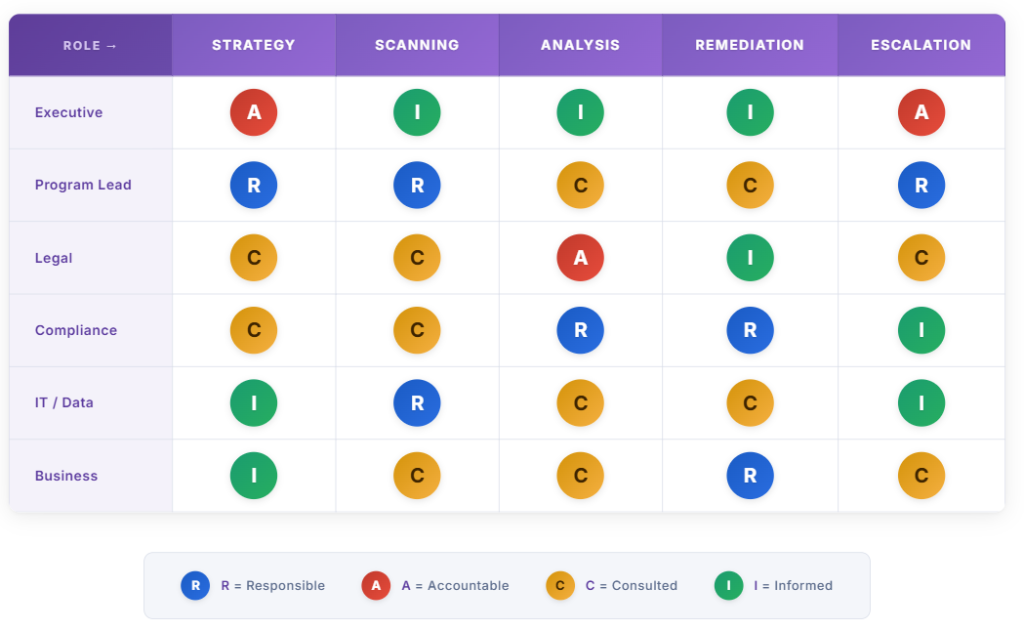
- Accountability for cross-jurisdictional coverage and resourcing
- Escalation point for material regulatory changes
- Board reporting on regulatory preparedness
- Day-to-day management of scanning cadence
- Vendor relationships and platform administration
- Taxonomy governance and reporting
- Coordination across functions
- Confirm legal obligations and interpretations
- Define regulatory risk appetite
- Advise on enforcement exposure
- Map obligations to controls and procedures
- Lead remediation projects
- Update policies and training
- Integrate APIs and automation
- Ensure data security and vendor risk management
- Support platform scalability
- Assess operational impact
- Implement remediation within business processes
- Provide feedback on feasibility and timelines
Define clear authority for:
- Prioritisation decisions (who approves resource allocation)
- Interpretation disputes (who resolves conflicting legal/compliance views)
- Escalation thresholds (when issues reach executive level)
- Documentation ownership (who maintains audit trails)
Tools, Technology, and Vendor Selection
Evaluation Criteria
When selecting tools, assess:
Coverage and Source Quality
- Number of jurisdictions and regulators monitored
- Direct primary source feeds vs. secondary aggregation
- API availability and update frequency
- Historical archive depth
Integration and Workflow
- APIs to connect with GRC, ERM, ticketing systems
- Workflow automation for task assignment and escalation
- Audit trail features and evidence export
- Dashboard and reporting capabilities
Automation and AI Capabilities
- NLP accuracy for obligation extraction
- False-positive rates and precision/recall metrics
- Configurable taxonomies aligned to your business
- Summarization quality and confidence scoring
Security and Vendor Risk
- Data residency and sovereignty controls
- Vendor security certifications (SOC 2, ISO 27001)
- Business continuity and uptime SLAs
- Contractual protections for confidential information
Total Cost of Ownership
- Subscription/licensing fees
- Implementation and integration costs
- Training and change management
- Ongoing maintenance and support
Pricing Benchmarks (based on market research):
- Entry-level specialist modules: $20,000–$50,000/year
- Enterprise platforms: $100,000–$500,000+/year
- Implementation services: 20–50% of first-year licensing
Build vs. Buy Decision
Buy if:
- Multi-jurisdictional coverage is critical
- AI/NLP capabilities are needed
- Integration with existing GRC is prioritized
- Speed to deployment matters
Build if:
- Highly specialized domain with limited vendor coverage
- Unique taxonomy requirements
- Strong in-house data science capabilities
- Cost sensitivity with long-term view
Hybrid Approach: Use vendor content feeds with custom-built workflow and integration layers.
Frequency, Cadence, and Sector Considerations
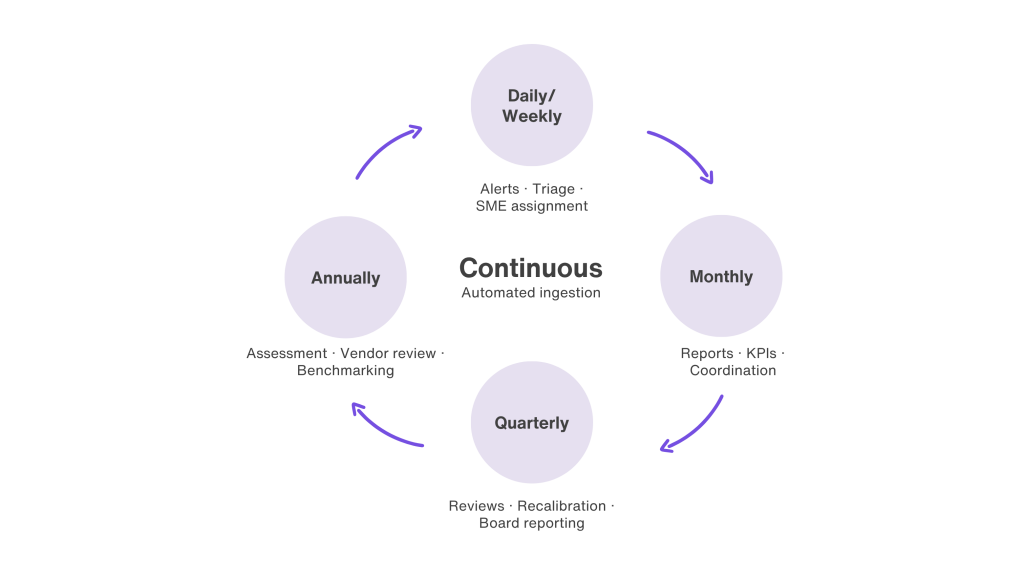
Recommended Cadence
Continuous: Automated ingestion from high-priority sources (regulator websites, APIs)
- Alert reviews for high-risk jurisdictions
- Triage of new proposals and consultations
- SME assignment for impact assessment
- Program reviews and taxonomy updates
- Prioritization recalibration
- Board/executive reporting
- Horizon reports for strategic planning
- KPI dashboards for management
- Cross-functional coordination meetings
- Comprehensive source coverage assessment
- Vendor performance reviews
- Benchmarking against industry peers
- Dense cross-border rulemaking (AML, digital assets, Basel reforms)
- Real-time, multi-jurisdictional coverage essential
- Close liaison with government affairs for policy strategy
- Examples: FCA Emerging Technology Horizon Scan, SEC rulemaking tracker
- Permitting, planning, and technical standards focus
- Rapid policy shifts in sustainability and climate regulations
- Supply chain and product stewardship requirements
- Examples: EU Green Deal, CBAM, battery regulations
- 3–10 year scientific and regulatory preparedness horizon
- Collaborative reporting with regulators (EMA horizon scanning programs)
- Focus on clinical trials, pharmacovigilance, manufacturing standards
- Point-of-care manufacturing and personalized medicine implications
- AI governance and algorithmic accountability
- Data privacy and cross-border data flows
- Platform regulation and content moderation
- Cybersecurity and operational resilience
Common Challenges and Mitigations
Challenge 1: Information Overload
Problem: Too many alerts, false positives, analyst fatigue
Mitigations:
- Rigorous scoping and taxonomy definition before tool deployment
- Hybrid filtering (automated + human review)
- Confidence scoring to prioritize review queues
- Regular refinement of keyword rules and ML models
Challenge 2: Missed Niche Sources
Problem: Important regulations from smaller regulators or specialized bodies slip through
Mitigations:
- Annual source coverage review against known risk areas
- Industry association participation for early warnings
- Peer benchmarking and information sharing
- Vendor coverage validation during procurement
Challenge 3: False Sense of Security
Problem: Over-reliance on automation without legal interpretation
Mitigations:
- Maintain human-in-the-loop for legal conclusions
- Document interpretation rationale and confidence levels
- External counsel review for high-impact items
- Regulatory engagement to clarify ambiguities
Challenge 4: Vendor and Data Security Risk
Problem: Third-party platforms access sensitive business information
Mitigations:
- Comprehensive vendor due diligence (security, financial stability, references)
- Contractual protections for data confidentiality
- Regular vendor risk assessments
- Exit strategies and data portability requirements
Challenge 5: Integration Failures
Problem: Horizon scanning outputs don’t translate into operational action
Mitigations:
- Embed outputs into change-management and policy update workflows
- Link to budget cycles for funded workstreams
- Define clear RACI for remediation ownership
- Track closure rates and escalate delays
Measuring Success — KPIs and ROI
Process KPIs
- Mean Time to Detect: Target reduction from days/weeks to hours (vendor benchmarks suggest 70–90% improvement)
- Percentage Mapped Within SLA: Target >90% for high-priority items
- False-Positive Alert Rate: Target <20% after tuning
- Remediation Closure Rate: Target >85% on-time completion
Outcome KPIs
- Compliance Incidents Avoided: Track near-misses and issues prevented through early action
- Cost Savings from Early Remediation: Compare planned vs. emergency implementation costs
- Regulatory Examination Findings: Reduce findings related to regulatory change management
- Time-to-Market for Compliant Products: Accelerate launch timelines through proactive compliance
ROI Calculation Framework
Benefits:
- Reduced implementation costs (emergency vs. planned)
- Avoided penalties and enforcement actions
- Competitive advantage from first-mover compliance
- Workforce efficiency from automation
Costs:
- Platform licensing and implementation
- FTE time for monitoring and assessment
- Training and change management
- Ongoing maintenance and vendor management
ROI Formula: (Benefits − Costs) / Costs × 100
Industry benchmarks suggest ROI of 200–400% for mature programs, though organisation-specific factors vary significantly.
Implementation Roadmap - From Start to Maturity
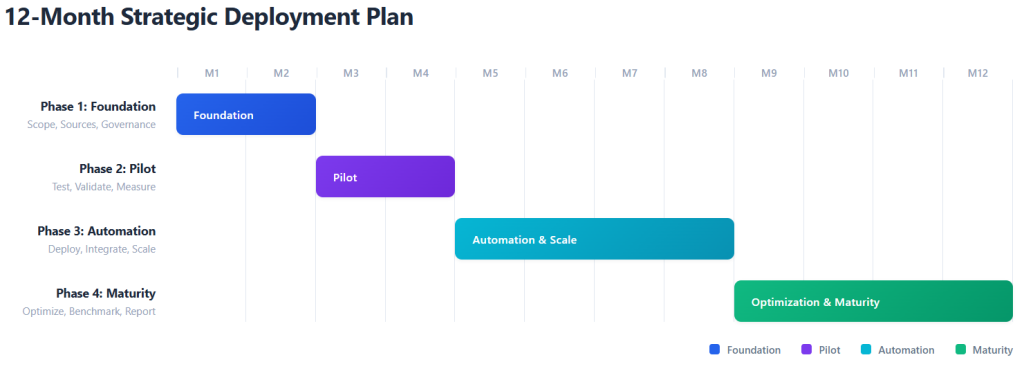
Phase 1: Foundation (Months 1–2)
Objectives: Define scope, identify sources, establish governance
Activities:
- Build regulatory universe and taxonomy
- Identify primary sources and prioritize by risk
- Define roles and responsibilities
- Select initial tooling (start with manual processes if needed)
Deliverables:
- Scope matrix and source list
- Governance charter and RACI
- Initial impact assessment template
Phase 2: Pilot (Months 3–4)
Objectives: Test process with limited scope, validate approach
Activities:
- Focus on one high-risk jurisdiction or business line
- Implement manual or semi-automated monitoring
- Conduct impact assessments and track remediation
- Measure initial KPIs
Deliverables:
- Pilot program report with lessons learned
- Refined templates and workflows
- Business case for scaling (if successful)
Phase 3: Automation and Scale (Months 5–8)
Objectives: Deploy technology, expand coverage, integrate workflows
Activities:
- Procure and implement horizon scanning platform
- Integrate with GRC and ticketing systems
- Expand to additional jurisdictions and business units
- Train stakeholders on workflows and tools
Deliverables:
- Automated monitoring across priority sources
- Integrated workflow from detection to remediation
- Dashboard and reporting capabilities
Phase 4: Optimization and Maturity (Months 9–12)
Objectives: Continuous improvement, advanced analytics, strategic integration
Activities:
- Refine AI/ML models based on feedback
- Implement advanced prioritization and risk scoring
- Integrate with strategic planning and product development
- Benchmark against industry best practices
Deliverables:
- Mature KPI dashboard with trend analysis
- Documented best practices and playbooks
- Executive reporting on regulatory preparedness
The Future of Horizon Scanning — AI and Emerging Trends
Recent advances in LLM applications for regulatory horizon scanning demonstrate:
- Automated summarization: Condensing lengthy regulatory texts into actionable insights
- Obligation extraction: Identifying specific requirements from unstructured text
- Semantic search: Finding relevant regulations using natural language queries
- Impact prediction: Assessing potential business implications based on historical patterns
Caveats:
- LLMs require strict filters and high-sensitivity settings in safety-critical domains
- Human review remains essential for legal interpretation
- Provenance and audit trails must be preserved
- Model drift and accuracy degradation require ongoing monitoring
Emerging platforms use agentic AI to:
- Continuously monitor thousands of sources simultaneously
- Auto-classify and route regulatory changes to appropriate owners
- Generate draft impact assessments and policy updates
- Track remediation progress and escalate delays
Market trends indicate:
- Consolidation of vendor capabilities through M&A (Mergers and Aquisitions)
- Shift from manual monitoring to AI-enabled platforms
- Cloud-native solutions dominating new deployments
- Integration of horizon scanning with broader compliance and risk management suites
How AI Is Changing Regulatory Horizon Scanning
Artificial intelligence (AI) is becoming an important enabler of modern regulatory horizon scanning. As the volume, complexity and speed of regulatory change continue to increase, manual monitoring alone is no longer sufficient for many regulated firms. Compliance teams are expected to track more sources, interpret more complex publications and respond faster, often with the same or fewer resources.
However, AI should not be treated as a replacement for legal, compliance or risk expertise. Regulatory interpretation requires context, judgement and accountability. AI can accelerate the process, but human experts remain essential for validating obligations, confirming applicability, assessing risk and approving final actions.
FinregE’s approach to AI-enabled regulatory intelligence is built around this principle: AI should support expert compliance teams, not replace them.
FinregE’s AI can help transform regulatory publications into structured intelligence by supporting summarisation, classification, relevance analysis and mapping to the firm’s internal compliance framework. This gives legal, risk and compliance teams a faster starting point for review while preserving the need for expert validation and accountable decision-making.
As AI capabilities continue to evolve, the most successful firms will be those that combine automation with strong governance. The future of horizon scanning is not simply about faster alerts. It is about creating a connected, explainable and auditable system where regulatory intelligence flows directly into impact assessment, policy and control updates, remediation workflows and board-level oversight.
How FinregE Turns Horizon Scanning into End-to-End Traceability
FinregE is designed to help regulated firms move from passive regulatory monitoring to a structured, auditable and proactive compliance workflow. Instead of treating horizon scanning as a standalone activity, FinregE connects regulatory intelligence with the wider compliance lifecycle – from initial detection through to impact assessment, policy and control mapping, remediation, reporting and closure.
FinregE helps firms:
- Monitor regulatory developments across multiple jurisdictions and sources.
- Classify updates by topic, regulator, jurisdiction, business area and relevance.
- Summarise complex regulatory publications into actionable insights.
- Assess impact against products, services, policies, controls and obligations.
- Identify gaps and remediation actions.
- Assign ownership to legal, compliance, risk, operations and business teams.
- Track regulatory change from identification to closure.
- Maintain evidence, version history and audit trails.
- Produce dashboards and reports for management, committees and boards.
This makes horizon scanning more than an early-warning system. It becomes a core part of the firm’s Regulatory Operating System, helping organisations anticipate change, understand impact and act with confidence.
Building a Proactive Compliance Culture
Regulatory horizon scanning is not just a tool or process — it’s a strategic capability that enables organisations to anticipate change, mitigate risk, and seize opportunities in an increasingly complex regulatory landscape.
Key Takeaways:
- Start with scope, not tools: Define your regulatory universe and taxonomy before deploying technology to avoid noise and false positives.
- Combine automation with human expertise: AI accelerates detection and classification, but legal interpretation and decision-making require subject-matter experts.
- Integrate into operations: Horizon scanning outputs must translate into funded workstreams, updated controls, and measurable remediation.
- Measure what matters: Focus on preparedness, decision quality, and remediation effectiveness rather than prediction accuracy.
- Govern centrally, execute federated: Maintain consistent coverage and auditability while delegating impact assessment to business units.
- Continuously improve: Regular program reviews, KPI tracking, and feedback loops ensure horizon scanning remains relevant and effective.
Organisations that master regulatory horizon scanning transform compliance from a cost center into a strategic advantage — enabling faster innovation, stronger risk management, and sustainable growth in regulated markets.
Appendix: Practical Templates and Resources
Regulatory Impact Assessment Worksheet
Field | Description |
Source Citation | Link to original regulatory document |
Summary | 2–3 sentence overview of the change |
Legal Obligations | Specific requirements created or modified |
Affected Products/Processes | Business areas impacted |
Control Mapping | Current policies and controls affected |
Gap Analysis | What’s missing to achieve compliance |
Remediation Actions | Specific tasks required |
Owners | Assigned accountability for each action |
Deadlines | Target completion dates |
Confidence Level | High/Medium/Low in interpretation |
Escalation Matrix Template
Severity | Trigger | Escalation Route | Timeline | Decision Required |
Critical | High penalty risk, <30 days to comply | Executive sponsor + Board | 24 hours | Budget approval, resource allocation |
High | Significant operational impact, 30–90 days | Compliance lead + Business unit head | 5 days | Prioritization, workstream creation |
Medium | Moderate impact, 90–180 days | Compliance manager | 2 weeks | Assessment assignment |
Low | Minor impact, >180 days | Analyst tracking | Monthly | Awareness only |
Vendor Shortlisting Questions
- How many jurisdictions and regulatory bodies do you monitor?
- What percentage of your sources are primary vs. secondary?
- What is your average alert latency from source publication?
- Can you demonstrate obligation extraction accuracy with sample documents?
- How configurable is your taxonomy to our business structure?
- What integrations do you support with GRC/ticketing systems?
- How do you preserve audit trails and source provenance?
- What are your uptime SLAs and business continuity provisions?
- Can you provide customer references in our industry sector?
- What is your pricing model and total cost of ownership over 3 years?
About the Expert Guide
This guide synthesises research from regulatory intelligence vendors, compliance practitioners, academic studies and regulator publications to provide actionable guidance for building effective horizon scanning programs.
Last Updated: July 2026