

Compliance teams today face an information overload problem. Regulatory bodies publish thousands of documents annually, consultations, final rules, guidance updates, supervisory letters, and thematic reviews. For organisations operating across multiple jurisdictions, the volume can reach tens of thousands of regulatory publications per year. The challenge is not finding regulatory information, it’s filtering it effectively.
The Regulatory Information Problem
Understanding the Scale
Consider a mid-sized organization operating in three jurisdictions:
- Jurisdiction A: 5 regulatory bodies, averaging 200 publications each annually = 1,000 documents
- Jurisdiction B: 3 regulatory bodies, averaging 300 publications each annually = 900 documents
- Jurisdiction C: 8 regulatory bodies, averaging 150 publications each annually = 1,200 documents
Total: 3,100 regulatory publications per year = approximately 60 documents per week
Now factor in:
- Draft consultations and discussion papers
- Speeches and statements from senior regulators
- Enforcement actions and thematic reviews
- Industry association updates and interpretations
- Secondary legislation and delegated acts
The actual volume can easily exceed 10,000 documents annually. Manual review of this volume is impossible, yet missing a critical requirement can expose the organization to significant risk.
The Cost of Poor Filtering
Ineffective regulatory filtering creates three types of problems:
- False Positives (Too Much Noise)
- Team time wasted reviewing irrelevant documents
- Alert fatigue causing important items to be missed
- Diluted focus on truly material changes
- False Negatives (Missed Signals)
- Critical requirements discovered too late
- Compliance gaps discovered during examinations
- Emergency implementation projects under pressure
- Inconsistent Application
- Different team members applying different relevance criteria
- No audit trail for filtering decisions
- Difficulty onboarding new team members
The Layered Filtering Framework
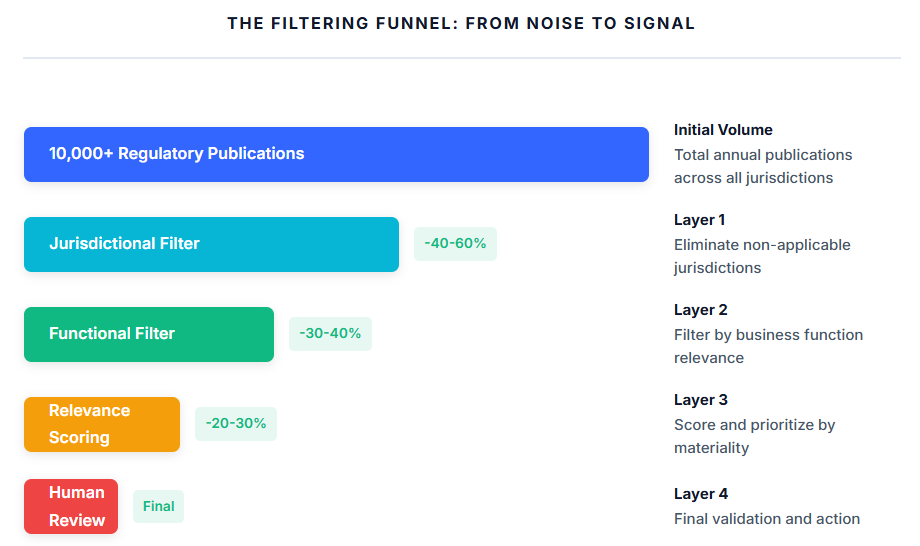
Effective regulatory filtering requires multiple layers, each designed to eliminate a portion of irrelevant content while preserving all material signals. Think of it as a funnel where each stage applies increasingly sophisticated criteria.
Layer 1: Jurisdictional Filtering
Purpose: Eliminate publications from regulatory bodies that have no authority over your organization.
Implementation Approach:
1. Maintain a Regulatory Footprint Registry
- Document every jurisdiction where you operate
- List all regulatory bodies with supervisory authority
- Note the specific regulations and requirements that apply
- Update quarterly or when business changes occur
2. Create Source-to-Jurisdiction Mappings
- Map each regulatory publication source to applicable jurisdictions
- Tag sources by regulatory body type (primary regulator, secondary regulator, industry body)
- Establish priority levels for different source types
3. Apply Automated Jurisdictional Exclusion
- Configure monitoring tools to exclude non-applicable jurisdictions
- Set up geographic filters for location-specific regulations
- Implement entity-level filtering for subsidiary-specific requirements
Example:
- Organization operates in: UK, EU, Singapore
- Excluded sources: US SEC, US state regulators, Australian ASIC
- Retained sources: UK FCA/PRA, EU ESAs, MAS Singapore
Expected Reduction: 40-60% of total regulatory publications eliminated
Maintenance Requirements:
- Quarterly review of business footprint changes
- Annual validation of regulatory source mappings
- Immediate updates when entering new jurisdictions
Layer 2: Functional Filtering
Purpose: Eliminate publications that, while from relevant regulators, don’t affect your operations.
Implementation Approach:
1. Define Functional Coverage Areas
- Map organizational functions to regulatory domains
- Examples: Compliance, Risk, Technology, Operations, Finance, HR
- Document which regulations affect each function
2. Create Topic Taxonomies
- Develop standardized topic categories (e.g., “Data Protection,” “Anti-Money Laundering,” “Conduct Risk”)
- Map regulations to topics
- Tag publications by relevant topics during intake
3. Apply Function-Based Filtering
- Configure alerts based on functional relevance
- Create role-specific filtering rules (e.g., Technology team only sees tech-related regulations)
- Implement cross-functional tagging for multi-domain regulations
Example Taxonomy:
Primary Topics:
- Governance and Culture
- Financial Crime and AML
- Data Protection and Privacy
- Technology and Cybersecurity
- Market Conduct and Trading
- Capital and Liquidity
- Consumer Protection
- Reporting and Disclosure
Secondary Tags:
- Policy Required
- System Changes Needed
- Training Required
- Reporting Changes
- Process Changes
Expected Reduction: 30-40% of remaining publications eliminated
Maintenance Requirements:
- Annual taxonomy review and refinement
- Quarterly validation of function-to-regulation mappings
- Feedback loop from business units on relevance accuracy
Layer 3: Relevance Scoring
Purpose: Prioritize publications within the relevant set based on materiality and impact.
Implementation Approach:
1. Develop Scoring Criteria Create a weighted scoring model based on:
Criteria | Weight | Indicators |
|---|---|---|
Regulatory Authority | 25% | Primary vs. secondary regulator; binding vs. guidance |
Scope of Application | 20% | Industry-wide vs. firm-specific; all firms vs. subset |
Content Type | 15% | Final rule vs. consultation vs. speech |
Subject Matter | 20% | Core business vs. peripheral activity |
Implementation Timeline | 10% | Immediate vs. long lead time |
Enforcement History | 10% | Active enforcement area vs. low priority |
2. Implement Automated Scoring
- Use keyword matching for initial scoring
- Apply machine learning models trained on historical relevance data
- Incorporate regulator priority signals (speeches, thematic reviews)
- Adjust scores based on organizational context
3. Create Priority Tiers
- High Priority (Score 80-100): Immediate review required
- Medium Priority (Score 50-79): Review within standard timeframe
- Low Priority (Score 20-49): Periodic review or archive
- Exclude (Score 0-19): Filtered out automatically
Example Scoring Decision:
Publication: FCA Consultation on Consumer Duty Implementation
- Regulatory Authority: Primary regulator (25/25)
- Scope: All consumer-facing firms (20/20)
- Content Type: Final guidance (12/15)
- Subject Matter: Core business activity (18/20)
- Timeline: 6 months implementation (8/10)
- Enforcement: Active priority area (10/10)
Layer 4: Human Review and Validation
Purpose: Apply human judgment to edge cases and validate automated filtering decisions.
Implementation Approach:
1. Establish Review Workflows
- Route high-priority items to designated reviewers immediately
- Queue medium-priority items for batch review
- Sample-check low-priority items periodically
- Escalate uncertain items to subject matter experts
2. Create Feedback Mechanisms
- Allow reviewers to mark items as correctly/incorrectly filtered
- Capture reasons for filtering decisions
- Use feedback to improve automated scoring models
- Document edge cases for future reference
3. Implement Quality Assurance
- Random sampling of filtered-out content for validation
- Periodic audit of filtering decisions
- Cross-review between team members for consistency
- Regular calibration sessions on scoring criteria
Expected Reduction: Continuous improvement in filtering accuracy
Maintenance Requirements:
- Weekly review queue management
- Monthly quality assurance sampling
- Quarterly calibration sessions
- Annual comprehensive filtering audit
Technical Implementation
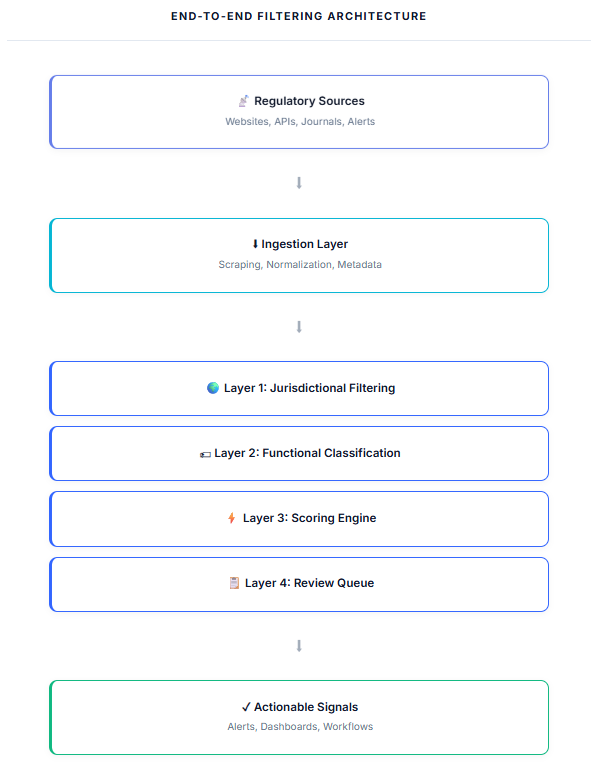
Architecture Overview
Key Technical Components
- Document Ingestion
- Web scrapers for regulator websites
- RSS feed aggregators
- API integrations with regulatory databases
- Email parsing for direct alerts
- Document format normalization (PDF, HTML, text)
- Text Processing
- Natural language processing for content analysis
- Named entity recognition for regulator and topic identification
- Keyword extraction and topic modeling
- Semantic similarity matching
- Classification and Scoring
- Rule-based filtering for deterministic decisions
- Machine learning models for probabilistic scoring
- Ensemble methods combining multiple approaches
- Continuous model retraining from feedback
- Workflow Integration
- Alert mechanisms (email, in-app, mobile)
- Task creation in compliance management systems
- Dashboard visualization of filtered signals
- Audit trail generation for all filtering decisions
Technology Selection Criteria
When evaluating regulatory intelligence platforms, assess filtering capabilities against these criteria:
Capability | Questions to Ask |
|---|---|
Jurisdictional Filtering | Can you define custom footprints? Can you exclude by geography or entity? |
Topic Classification | Is the taxonomy customizable? Can you create custom topics? |
Scoring Engine | Is scoring transparent and adjustable? Can you see why items scored as they did? |
Learning Capability | Does the system learn from your feedback? How quickly does it adapt? |
Integration | Does it connect to your existing compliance systems? Can you export filtered data? |
Audit Trail | Is every filtering decision logged? Can you review historical filtering decisions? |
Measuring Filtering Effectiveness
Track these metrics to ensure your filtering system is working correctly:
Efficiency Metrics
Metric | Target | Measurement |
|---|---|---|
Filtering Rate | 85-95% of content filtered | Percentage of total publications eliminated by layers 1-3 |
Review Time | <5 minutes per item | Average time spent reviewing each non-filtered publication |
Alert Volume | 10-20 per week | Number of items requiring human review |
Processing Time | <24 hours | Time from publication to team awareness |
Quality Metrics
Metric | Target | Measurement |
|---|---|---|
False Positive Rate | <10% | Percentage of filtered items later identified as relevant |
False Negative Rate | <2% | Percentage of relevant items missed by filtering |
Reviewer Satisfaction | >4/5 | Team feedback on alert relevance |
Coverage Confidence | >95% | Assurance that all material changes are captured |
Business Impact Metrics
Metric | Target | Measurement |
|---|---|---|
Time to Awareness | <48 hours | Time from publication to team notification |
Implementation Lead Time | +30 days average | Additional time gained for implementation planning |
Emergency Projects | <5 per year | Number of last-minute compliance implementations |
Team Capacity | +20% | Additional regulatory work possible with same resources |
Common Pitfalls and How to Avoid Them
Pitfall 1: Over-Filtering
Problem: Aggressive filtering causes important items to be missed.
Solution:
- Start with conservative filtering and tighten gradually
- Implement sampling of filtered-out content for validation
- Maintain a “watch list” for borderline topics
- Review false negatives quarterly and adjust criteria
Pitfall 2: Under-Filtering
Problem: Too many items pass through, overwhelming the team.
Solution:
- Tighten scoring thresholds
- Add additional filtering criteria
- Implement stricter jurisdictional boundaries
- Review and clean up topic taxonomies
Pitfall 3: Static Filtering Rules
Problem: Filtering rules don’t adapt to business changes.
Solution:
- Schedule quarterly filtering reviews
- Update footprint registry when business changes
- Refresh topic taxonomies annually
- Retrain ML models with recent data
Pitfall 4: Lack of Transparency
Problem: Team doesn’t understand why items were filtered.
Solution:
- Implement explainable scoring (show why items scored as they did)
- Provide filtering rationale with each decision
- Create documentation of filtering logic
- Train team on filtering criteria and rationale
Building Your Filtering System: A Practical Guide
Phase 1: Manual Foundation (Weeks 1-4)
Before investing in automation, establish your filtering logic manually:
1. Collect Historical Data
- Gather 6-12 months of regulatory publications
- Have team members tag relevance manually
- Document filtering decisions and rationale
2. Define Initial Criteria
- Create jurisdictional exclusion list
- Develop topic taxonomy
- Establish scoring rubric
3. Test and Refine
- Apply criteria to historical data
- Measure accuracy against known relevant items
- Adjust criteria based on results
Phase 2: Tool-Assisted Filtering (Months 2-4)
Introduce technology to support manual filtering:
1. Select and Configure Tools
- Choose platform matching your requirements
- Configure jurisdictional and functional filters
- Set up initial scoring rules
2. Run Parallel Systems
- Filter content both manually and automatically
- Compare results and identify gaps
- Tune automated filtering based on manual baseline
3. Gradual Transition
- Move to automated filtering for clear-cut cases
- Maintain manual review for edge cases
- Build team confidence in automated system
Phase 3: Optimized Automation (Months 5-12)
Achieve mature, self-improving filtering:
1. Enable Machine Learning
- Feed historical filtering decisions into ML models
- Enable continuous learning from team feedback
- Monitor model performance and accuracy
2. Integrate with Workflows
- Connect filtering output to compliance management systems
- Automate alert routing based on priority and function
- Create dashboard views of filtered signals
3. Establish Governance
- Document filtering policies and procedures
- Assign ownership for filtering maintenance
- Implement regular review and calibration cycles
Conclusion
Effective regulatory filtering is not about eliminating human judgment, it’s about amplifying it. By implementing layered filtering that handles routine decisions automatically while surfacing complex cases for human review, organizations can process regulatory information at scale without sacrificing accuracy or oversight.
The key is to start with clear criteria, implement systematic layers, measure performance rigorously, and continuously refine based on feedback. Organizations that master regulatory filtering transform information overload into competitive advantage, seeing regulatory changes earlier, understanding them better, and implementing them more efficiently than competitors struggling with noise.
Next Steps
Ready to transform your regulatory filtering? View our horizon scanning solution in action to see how automated layered filtering works in practice.