Regulators are becoming clearer about how prudential risk, conduct risk, and issues with market integrity can result from non-compliance with ESG and climate-related regulations. Businesses that fail risk more than just reputational harm.
ESG (Environment, Social and Governance) requirements are nowadays scattered across jurisdictions, incorporated in various regulatory systems, and implemented by a variety of means.
ESG compliance has significantly advanced beyond high-level sustainability narratives. It now directly affects risk management, disclosures, product governance, and supervisory outcomes for financial services companies.
As the European Banking Authority (EBA) stated, “We need to ensure that financial risks stemming from ESG factors are well-managed. ESG aspects are increasingly embedded across our products and activities.”
A climate disclosure obligation in the EU is very different from the UK’s ESG conduct and anti-greenwashing risk, a litigation-shaped and politically contested requirement in the United States, or an International Sustainability Standards Board (ISSB) rollout across APAC markets.
The result is not disagreement over sustainability goals, but rather fragmentation in how those goals are translated into binding legal and regulatory obligations.
IFRS (International Financial Reporting Standards) Foundation states:
“Jurisdictional modifications can lead to fragmentation, adding complexity to users of sustainability information and increasing costs and complexity for preparers subject to inconsistent regulatory requirements.”
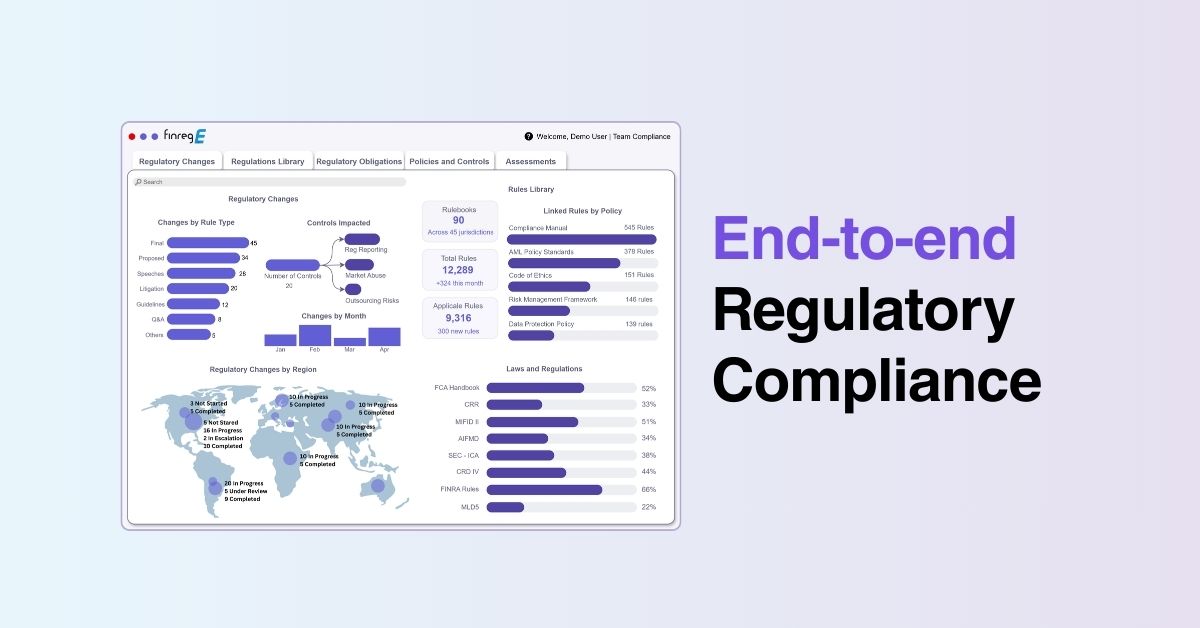
This fragmentation is exactly where FinregE comes in. We help firms to understand how these ESG and climate-related obligations differ across jurisdictions, track what applies where and when, and maintain control over the rules.
Why ESG and climate regulation are pulling apart
At a high level, ESG frameworks still communicate with one another.
Global standards such as ISSB (International Sustainability Standards Board) have an impact on many markets, and regulators frequently reference common concepts such as materiality, transition risk, and climate resilience.
Regulators are tailoring ESG regimes around their own priorities. Some focus on detailed corporate reporting. Others emphasise investor protection and marketing integrity. Some are shaped by legal risk or political limits.
Climate and ESG obligations are dispersed across corporate reporting rules, financial regulation, conduct requirements, and state or sector-specific laws.
The difficulty for multinational corporations is not a lack of knowledge, but determining which ESG rule applies, in what context, and with what consequences.
What divergence looks like across the EU, UK, APAC and US
The EU: the most structured, and the hardest to “half-comply” with
The EU has taken the most complete and integrated approach to ESG. The EU approach is built like an ecosystem with corporate reporting rules feeding sustainable finance disclosures, which then interact with classification and taxonomy.
Under the Corporate Sustainability Reporting Directive (CSRD), the first in-scope companies use the new rules for the FY 2024 for reports published in 2025, with reporting based on the European Sustainability Reporting Standards (ESRS).
In terms of sustainable finance, the EU’s Sustainable Finance Disclosure Regulation (SFDR) is now being assessed and consulted to improve legal certainty and usability, while also addressing greenwashing concerns.
Even if the EU adjusts its scope and timelines through simplification measures, the overall goal remains clear. In the EU, ESG is considered part of the formal regulatory architecture, rather than just a voluntary effort.
The UK: less about volume of reporting, more about conduct and claims risk
The UK has consciously chosen a different route.
Rather than matching EU-style reporting, the UK has focused ESG regulation on how sustainability claims are produced and how products are presented to the market. The Financial Conduct Authority’s (FCA) Sustainability Disclosure Requirements regime combines an anti-greenwashing rule with product labels, naming rules, and targeted disclosures.
The UK government is about to publish finalised UK Sustainability Reporting Standards (SRS S1 and S2) for voluntary use in early 2026. Regarding taxonomy, the UK government determined that a UK Green Taxonomy should not be included in its sustainable finance framework.
This means ESG risk in the UK frequently develops outside of annual reports. It could appear in a fund name, a marketing statement, a website claim, or a client presentation. The regulatory question is not what a firm reports, but how it communicates sustainability characteristics and outcomes.
In practice, ESG in the UK operates similarly to financial promotions compliance, with a significant emphasis on clarity, substantiation, and consistency.
The US: fragmented, legally contested, and constantly in “status check” mode
Climate disclosures in the US do not follow a single framework, but are shaped by federal regulations, state rules and lawsuits.
The United States Securities and Exchange Commission (SEC) approved its climate-related disclosure rules in March 2024. The rules were challenged in court, and in March 2025, the SEC withdrew its defence of those rules.
California’s climate disclosure laws have been among the most significant sub-national developments. The laws are being contested, and courts have made decisions changing the timing or enforceability of some requirements.
According to recent reports, an appeals court paused a California law that was about to begin in January 2026 which requires covered companies to report on climate-related financial risks, while a separate emissions disclosure law remained in effect.
APAC: moving quickly toward ISSB-style baselines, but with local shape and staging
Many APAC markets are rapidly moving toward ISSB-aligned approaches, though implementation is phased, timelines differ, and assurance expectations vary.
Singapore’s Accounting and Corporate Regulatory Authority (ACRA) and Singapore Exchange Regulation (SGX RegCo) said that beginning with FY2025, issuers must report Scope 1 and 2 emissions and start incorporating ISSB climate-related requirements.
Hong Kong’s roadmap outlines a strategy requiring PAEs (Publicly Accountable Entities) to adopt ISSB Standards, with large PAEs to fully adopt no later than 2028.
Japan’s Sustainability Standards Board of Japan (SSBJ) issued its first sustainability disclosure rules in March 2025. Japan’s regulator has also released a roadmap outlining assurance timing and scope, which includes limited assurance beginning one year after mandatory application and initial assurance scope focusing on certain areas such as Scopes 1 and 2.
India’s SEBI (Securities and Exchange Board of India) framework has continued to evolve, with staged requirements for BRSR (Business Responsibility and Sustainability Report) Core and value chain ESG disclosures, as well as associated evaluation or assurance expectations.
Australia’s ASIC (Australian Securities & Investments Commission) has indicated that beginning January 1, 2025, many significant Australian corporations and financial institutions will be required to publish annual sustainability reports, which include mandated climate-related financial disclosures.
China’s authorities published a green finance-supported project catalogue in July 2025.
Across APAC, the baseline alignment is improving, but local rulebooks are still required.
What financial services firms need to change
Most regulated companies continue to manage ESG through reporting cycles and scattered trackers. That model is not scalable across different regimes.
A more resilient strategy consists of four components.
- A live inventory of ESG obligations: Firms require a regularly updated ESG requirements, organised by jurisdiction, entity, product, topic, effective date, and evidence expectations.
- A shared data backbone with controlled outputs: Data collection and governance should be standardisedwhenever possible, while allowing for jurisdiction-specific disclosures.
- Controlled ESG communications: Sustainability claims should be governedjust like financial promotions: approved, substantiated, versioned, and monitored.
- Assurance ready traceability: Firms must be able to show which rule applied, what action was taken, and what evidence backs each disclosure or claim.
How FinregE helps firms manage ESG divergence
FinregE supports businesses by treating ESG and climate regulation as a regulatory change and governance challenge rather than a standalone ESG activity.
Tracking ESG and climate regulation as it evolves: FinregE regularly monitors ESG related regulatory developments across jurisdictions, capturing changes, timing, and enforcement actions so firms understand what applies to them at any given moment.
Making divergence visible: Instead of combining ESG into a single framework, FinregE enables businesses to understand how requirements differ by jurisdiction, entity, product, and topic. This helps teams to manage overlap where it exists while avoiding divergence where it does not.
Supporting structured interpretation and accountability: Using FinregE’s regulatory intelligence workflows, firms can understand complex ESG requirements, document decisions, and maintain a clear audit trail as rules evolve.
Maintaining control as assurance expectations grow: As regulators, auditors, and stakeholders become more concerned about ESG and climate disclosures, FinregE assists firms in demonstrating what they considered, what they applied, and why.
The firms that will succeed will not be the ones with the best sustainability narrative, but it will be the ones with the best data controls, more transparent governance, and an operating model that can withstand divergence without requiring continuous rebuilds.
Book a demo today.