The European Banking Authority (EBA) published its consultation on revisions to the ITS on supervisory reporting on 10 April 2026.
It is not one regulatory change. It is nine simultaneous module consultations, covering liquidity, FINREP, operational risk losses, stress testing, market risk, COREP own funds, ESG reporting, Pillar 3 alignment for SNCIs, and a suite of other CRR3-driven amendments, packaged under the banner of supervisory reporting simplification, with a main consultation deadline of 10 July 2026 and a first reporting date of 30 September 2027.
For FINREP templates mainly affected by IFRS 18, the earlier deadline is 10 May 2026. The EBA plans to finalise the revised ITS by the end of 2026, with first reporting expected for the reference date of 30 September 2027. It also signals transitional arrangements for obligations that apply earlier, especially IFRS 18-related FINREP changes and operational risk loss reporting.
Simplification is the right word for what the EBA is aiming for. It is not the right word for what this consultation will require from your reporting, finance, risk, data, and governance teams over the next 18 months.
The institutions that move first — that read this package as a cross-functional transformation programme rather than a reporting update — will have 18 months to implement it well. The ones that wait for the final ITS will have considerably less.
Nine Modules. One Interconnected Impact.
The EBA has been clear that this is not a standard targeted fix. It is a comprehensive review of the ITS on supervisory reporting after fifteen years of harmonisation, a deliberate attempt to reduce duplication, improve proportionality, and build a framework that serves supervisors without imposing disproportionate burden on institutions. The ambition is legitimate. The operational complexity of responding to it is not small.
The nine modules are designed to be read as parts of one package. But they create obligations that land across different teams, systems, timelines, and data ownership models. A firm that manages them as nine separate workstreams will create gaps, duplications, and governance failures. A firm that maps them as one connected programme will have a clearer picture of what changes, what stays, what can be done in parallel, and where the critical path runs.
The modules also differ significantly in what they are doing. Some are reducing burden – removing underused templates, lowering frequencies, extending proportionality relief for smaller institutions. Others are introducing new structure: a new ESG reporting framework, a new shadow banking exposure template, new COREP transitional monitoring requirements, and the integration of stress test starting-point data into regular reporting. Treating the whole package as ‘simplification’ risks misallocating implementation effort.
Where the EBA Reduces Burden and Where It Does Not
The most important analytical distinction a reporting team can make right now is between proposals that genuinely reduce operational load and proposals that restructure how reporting is done, and therefore still require significant systems, data, and governance work, even if the eventual steady-state is leaner.
Where simplification is real
- Removal of underused or duplicative templates in FINREP and liquidity reporting, reducing the raw volume of data points firms must compile
- Lower reporting frequencies for certain data collections where supervisory need does not justify quarterly or monthly submission
- Proportionality expansion for SNCIs and smaller institutions – reduced scope, simplified templates, and in some areas explicit exemptions
- Greater integration of stress test starting-point data into regular supervisory reporting, replacing parallel ad hoc collections with a more structured ongoing mechanism
Where the work remains substantial
- ESG reporting introduces a new supervisory framework, not a simplification of an existing one. Three differentiated template sets, new materiality thresholds, and alignment requirements with Pillar 3 disclosures. This is greenfield work, not reduction.
- Shadow banking exposure adds a new consolidated and solo template (LE4 / C 37.00), tracking aggregate exposure to shadow banking entities. New data requirements, new mapping, new governance.
- FINREP under IFRS 18 requires structural redesign of financial statement-linked templates as accounting standards change. The EBA acknowledges transitional arrangements will be needed.
- COREP own funds introduces a new template (C 05.03) for CRR3 transitional arrangements monitoring. New capital governance data flowing into supervisory reporting.
- Reporting change management itself is being formalised as a discipline, with the EBA proposing earlier communication, structured stakeholder engagement, and more predictable implementation calendars. That is a governance uplift, not a burden reduction.
Simplification does not mean the same thing to the EBA as it does to your IT architecture team. The firms that understand the difference early will implement better and respond to the consultation with greater credibility.
What 'Lighter Touch' Actually Requires from SNCIs
The EBA’s proportionality proposals are genuinely meaningful. Across multiple modules, smaller and less complex institutions benefit from reduced template sets, lower frequencies, and in some cases explicit exemptions. For SNCIs specifically, the ESG module proposes a differentiated and lighter template set, a recognition that applying large institution ESG disclosure requirements to smaller banks creates burden with limited supervisory value.
Here is the operational reality that the proportionality narrative can obscure: even the lighter-touch tier requires you to know which tier you are in, what obligations apply to that tier, how your existing data covers those requirements, and what governance structures support ongoing compliance with a framework that may be updated.
For institutions in the SNCI or non-listed category, the practical work of proportionality is not simply ‘less reporting.’ It is: understanding the perimeter of your obligations, evidencing that your classification is correct, mapping a lighter but still structured template set to your data and systems, and staying current as the framework evolves.
FOR SNCIS SPECIFICALLY
The ESG module proposes three differentiated template sets: one for large institutions, one for other listed institutions and large subsidiaries, and one for SNCIs and other non-listed institutions. The third set is lighter, but it is not optional, and it is not formless. Understanding exactly what it requires, how it maps to your existing disclosure and risk data, and how it aligns with Pillar 3 obligations is a concrete implementation exercise that starts now, not in 2027.
The EBA Is Asking for Evidence. Most Firms Will Not Provide It.
The EBA has been explicit: it wants to hear from institutions about which proposals genuinely reduce burden, which create unintended transition costs, and where alternative design choices might better support proportionality and usability in practice. The consultation is not a formality. It is an active input mechanism into how the final ITS is designed.
Firms that respond with specific operational evidence, data architecture constraints, system change costs, implementation timeline conflicts, concrete examples of where a proposed simplification creates a new complexity, have genuine influence over the final framework. Firms that submit generic acknowledgements of the consultation or skip the response entirely have none.
That makes the consultation response a strategic asset, not a compliance task. But writing a credible, evidence-based response to nine modules requires structured impact assessment, cross-functional input, and a clear way to trace proposed regulatory obligations to internal systems, processes, and costs. Most firms do not have that infrastructure in place.
One Programme, Not Nine Workstreams: How FinregE Structures the Response
The core operational challenge of this consultation is not understanding the EBA’s intent. It is managing nine simultaneous module assessments, cross-functional ownership, two comment deadlines, and an 18-month implementation runway, without losing coherence, duplicating effort, or missing material obligations.
FinregE is built for exactly this kind of regulatory moment. The platform does not just help firms read regulation. It helps them convert regulation into structured, owned, evidenced action, across every module, every function, and every relevant deadline.
One unified view across all nine modules
Before any impact assessment can be done, firms need a single, structured picture of what the EBA has proposed across the full package. FinregE’s AI RIG ingests all nine module papers and the umbrella consultation, extracts obligations, maps applicability by institution type, and surfaces the consultation questions that require a formal response. What typically takes a regulatory affairs team three to four weeks of manual reading, annotation, and synthesis is available in structured form from day one.

Impact assessment tied to templates, systems, and ownership, not just text
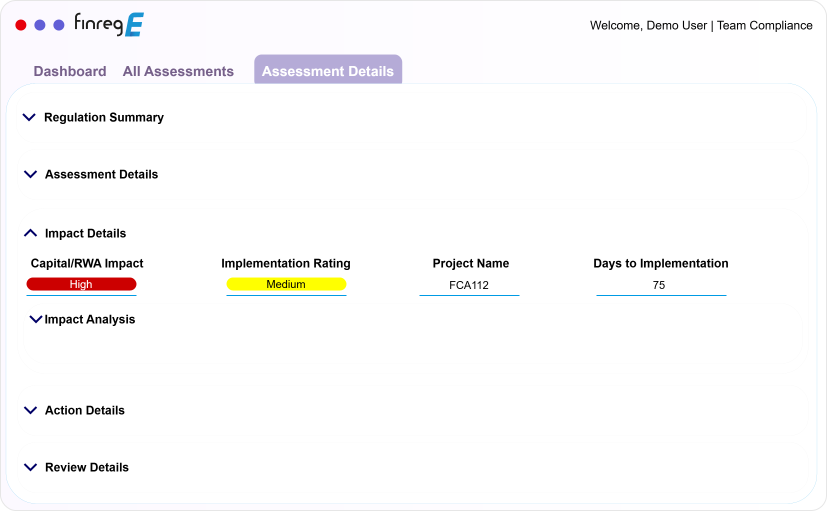
The EBA is explicitly asking for evidence on operational cost and feasibility. That evidence must come from somewhere. FinregE’s impact assessment workflows translate proposed regulatory changes, by module, by template, by data element – into structured assessments linked to source systems, data owners, control points, and implementation effort. The result is not a generic summary of what has changed. It is a prioritised, ownership-mapped picture of what your institution specifically needs to do.
IFRS 18 and FINREP: managing the earlier deadline
The FINREP issues linked to IFRS 18 show why this consultation cannot be managed as one undifferentiated package. Some elements carry more immediate timing and implementation pressure than others, and firms need a way to keep those strands visible while still managing the consultation. FinregE helps by turning those requirements into structured assessments with owners, deadlines, workflow tracking, evidence capture, and management visibility. That makes it easier to run FINREP-related work as a distinct, time-sensitive stream within the broader programme, while preserving traceability and coordination across the wider response.
ESG reporting: structuring greenfield obligations by institution type
The ESG dimension is another area where structure matters. Where new supervisory reporting expectations emerge, firms need a clear way to understand scope, map obligations into internal frameworks, identify gaps, and coordinate remediation. FinregE can support that through structured regulatory content, applicability views, AI-assisted analysis, and RIGMAPS, which maps obligations to internal policies, procedures, and controls and highlights areas where coverage is partial or missing. The value is not just in finding gaps. It is in creating a more traceable readiness view that can be assessed, owned, and progressed through workflow.
Consultation response: from internal evidence to structured submission
A credible EBA consultation response requires traceability — from regulatory proposal to internal impact assessment, to operational evidence, to the position your institution is taking and why. FinregE structures that chain from end to end. The platform captures assessments, cost evidence, implementation observations, and proposed alternatives in a form that can be translated directly into a consultation response — reducing the distance between internal analysis and external submission without the manual reconciliation that typically consumes weeks of regulatory affairs bandwidth.


What Firms Should Be Doing and When
The IFRS 18 FINREP deadline is 10 May 2026. The main consultation closes 10 July 2026. Neither is far away. Start with the critical actions immediately — and treat the whole package as one programme, not eight separate module reviews.
Required Action | Owner | By When | Priority |
Establish a cross-functional EBA reporting simplification programme | CFO / CRO / Head of Regulatory Reporting | Immediate | High |
Perform module-by-module impact assessment across all nine modules | Compliance / Reg Reporting / Finance / Risk | Immediate | High |
Identify simplification vs redesign-heavy proposals and prioritise accordingly | Reporting Transformation / IT / Data Governance | Near-term | High |
Assess IFRS 18 readiness and prepare separate FINREP response by 10 May 2026 | Finance / Accounting Policy / Reg Reporting | Immediate — 10 May 2026 | High |
Review ESG reporting implications by institution type, template set, and data availability | ESG Reporting / Risk / Finance | Near-term | High |
Assess shadow banking, large exposure, and COREP transitional arrangement impacts | Risk / COREP Reporting / Capital Teams | Near-term | Medium |
Prepare formal consultation response with evidence, cost analysis, and operational examples | Compliance / Public Policy / Regulatory Affairs | By 10 Jul 2026 | High |
Revisit reporting governance, taxonomy ownership, and change management ahead of Sep 2027 | PMO / Reporting Governance / IT | Ongoing | Medium |
18 Months Is Less Time Than It Looks
The first reporting reference date under the revised EBA framework is 30 September 2027. That is 18 months from now. For institutions that have not started impact assessment, that timeline will feel comfortable today and impossible in Q1 2027.
The EBA has structured this consultation deliberately in modular format, explicit feedback requests, proportionality differentiation, and a stated commitment to more predictable implementation calendars. The intent is to build a better framework with industry input. The execution risk for individual institutions is real regardless of that intent.
Nine modules. Two deadlines. Cross-functional ownership. New data requirements in ESG and shadow banking. Structural redesign in FINREP. New capital governance templates in COREP. And a consultation window that closes in July.
The firms that treat this as a comprehensive transformation programme, not a reporting update to be assessed module by module in isolation, will arrive at September 2027 with a compliant, evidence-based, well-governed reporting framework. The firms that do not will spend the final six months of that window in emergency implementation mode.
The EBA is simplifying the framework. That does not simplify the transition. Start the programme now.
See how FinregE manages the EBA’s nine-module consultation as one connected programme.
From regulatory text to obligation mapping, impact assessment, gap analysis, and consultation response – structured, evidenced, and audit-ready.